
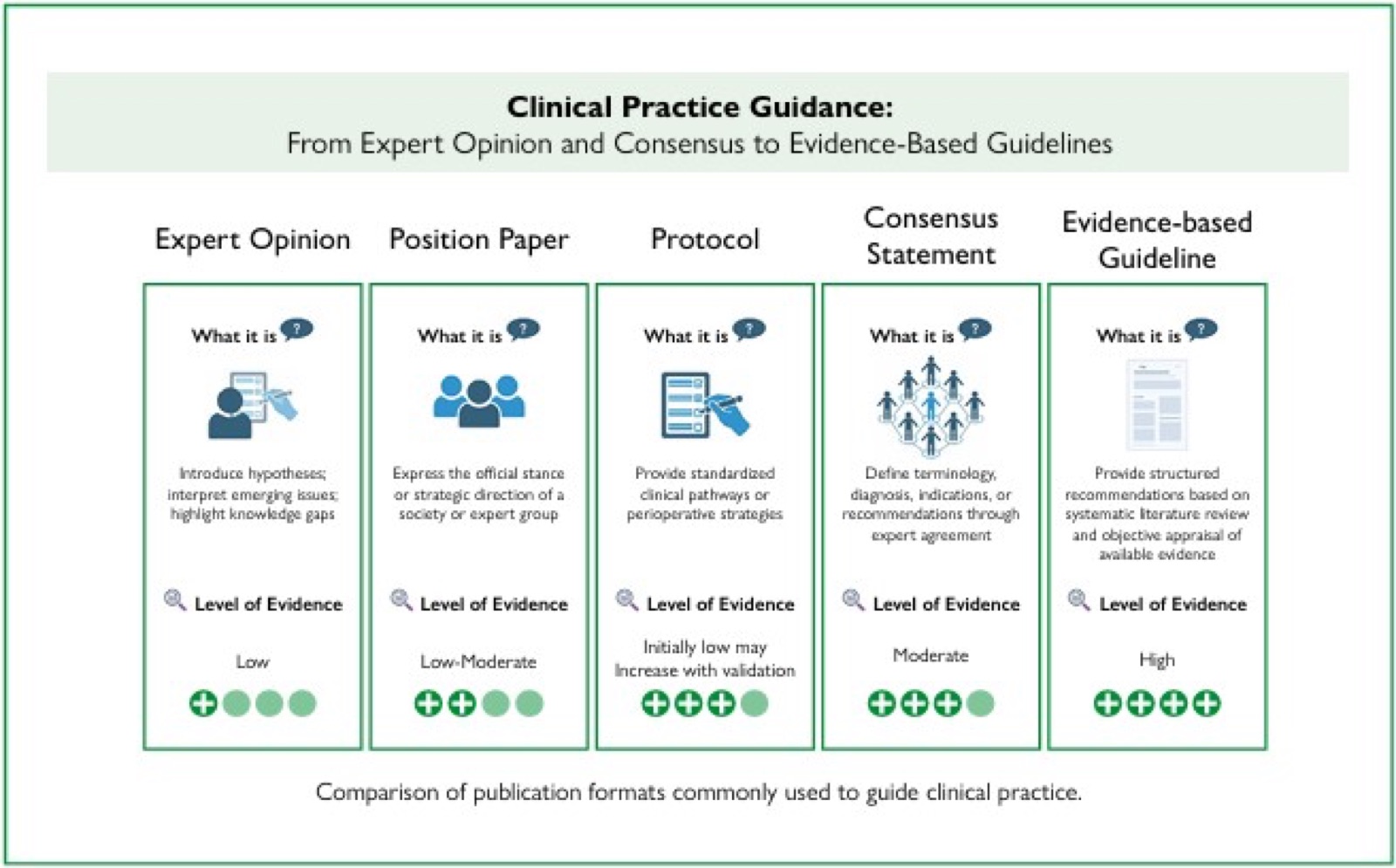
The growth of primary research in digestive surgery has led to an increasing need for structured interpretation and application to clinical practice. Guidance documents have become essential tools for decision-making. However, the terminology surrounding clinical guidance documents is frequently inconsistent, and different formats are often used interchangeably. Although review articles synthesize available evidence, they do not constitute clinical guidance unless their findings are interpreted through a framework explicitly oriented toward patient care, applicability, and decision-making. This review article clarifies the conceptual distinctions between expert opinion, consensus statements, position papers, protocols, and evidence-based guidelines. No single guidance format is universally superior, and each has its appropriate context. In digestive surgery, where randomized trials are often difficult to perform and evidence gaps remain frequent, structured interpretation is indispensable. As technology advances and real-world data become increasingly available, new methodological tools — including artificial intelligence and living systematic reviews — may enhance reproducibility and accelerate updates. Ultimately, clearer distinctions among guide orientations and greater methodological transparency may improve clinical judgment, stimulate research, and strengthen patient care in gastrointestinal surgery.
The concept introduced by protocols of enhanced recovery after surgery modifies perioperative traditional care in digestive surgery. The integration of these modern recommendations components during the perioperative period is of great importance to ensure fewer postoperative complications, reduced length of hospital stay, and decreased surgical costs.
To emphasize the most important points of a multimodal perioperative care protocol.
Careful analysis of each recommendation of both ERAS and ACERTO protocols, justifying their inclusion in the multimodal care recommended for digestive surgery patients.
Enhanced recovery programs (ERPs) such as ERAS and ACERTO protocols are a cornerstone in modern perioperative care. Nutritional therapy is fundamental in digestive surgery, and thus, both preoperative and postoperative nutrition care are key to ensuring fewer postoperative complications and reducing the length of hospital stay. The concept of prehabilitation is another key element in ERPs. The handling of crystalloid fluids in a perfect balance is vital. Fluid overload can delay the recovery of patients and increase postoperative complications. Abbreviation of preoperative fasting for two hours before anesthesia is now accepted by various guidelines of both surgical and anesthesiology societies. Combined with early postoperative refeeding, these prescriptions are not only safe but can also enhance the recovery of patients undergoing digestive procedures.
This position paper from the Brazilian College of Digestive Surgery strongly emphasizes that the implementation of ERPs in digestive surgery represents a paradigm shift in perioperative care, transcending traditional practices and embracing an intelligent approach to patient well-being.




Developed by Surya MKT