
Gastric cancer remains an important cause of morbidity and mortality in our country4. Surgical resection has been the cornerstone of curative treatment, while the incorporation of new therapeutic modalities, particularly systemic chemotherapy, has contributed to improved patient survival1. Nevertheless, major management challenges persist, including late diagnosis, with nearly half of patients presenting with stage IV disease at diagnosis, limited access to contemporary chemotherapy regimens, and insufficient availability of treatment in specialized centers capable of providing integral, comprehensive multidisciplinary care2,3. The Brazilian Gastric Cancer Association (ABCG), founded in 1999, brings together specialists involved in the treatment of gastric cancer in Brazil, with a strong focus on continuing medical education and professional training4. As part of its activities, the Association organizes an annual scientific meeting. During the 2025 meeting, a “Commitment Letter” was drafted and formally delivered to the Secretary of Health of the city of Rio de Janeiro, Mr. Daniel Ricardo Soranz Pinto, outlining key demands and strategic actions considered necessary to improve gastric cancer outcomes in Brazil. This initiative was the first ABCG’s advocacy effort in this context. In this editorial, we share the contents of this Commitment Letter to broaden awareness within the Brazilian surgical and oncological community. We believe that, in addition to their educational and scientific roles, medical associations should advocate for patients and actively engage with health authorities to support policies that improve cancer care. We hope this initiative is seen as an example to be followed by other national medical societies.
The thesis, entitled Determination of the optimal points for resection of ischemic intestinal loops by “Dopplerometry, Thermometry and Fluoresceinoscopy: Experimental study in dogs”, analyzed a topic — intestinal ischemia and extensive resections — in which I was very interested2. Once again, I was impressed with the clarity and didactics in the presentation of the work, as well as with the security and propriety in the answers to the formulated questions. During the flight back to São Paulo, in the company of Doctor Emil Burihan, Full Professor of Vascular Surgery at Escola Paulista de Medicina, now Universidade Federal de São Paulo (UNIFESP), also a member of the Judging Committee, we talked about the candidate and the thesis argument and concluded that we were witnessing the birth of a future great professor at UFMG. Doctor Paulo Roberto Savassi Rocha is a mineiro in heart and soul and, like any good mineiro, enchanted by his land, its history, and its values. He graduated from UFMG in 1969. After graduation, he worked for a period as an assistant to Professor Mahrdas Salvador Nankran, a renowned surgeon from Belo Horizonte, who contributed a lot to his training and growth. He then took the exam, being admitted as a resident of General Surgery at the Hospital das Clínicas of UFMG, in Belo Horizonte. After completing the residency program, he took another exam, this time joining as Teaching Instructor of the Surgery Service. He then enrolled in the Postgraduate Course (stricto sensu), defended his thesis and had a rapid and fulminant evolution in his academic career, reaching the position of Full Professor of Surgery in 1991. Its trajectory is very rich. In a short period of time, he became a well-known surgeon throughout Brazil. He is a constant figure in the most important surgical events, with dozens and dozens of lectures both in the country and abroad, being invited to numerous participations in examining committees of postgraduate theses and competitions in the academic career in several institutions in the country.
an exclusive mandatory health center for TB patients at the time, and an hour-and-a-half bus ride from the medical school classes. That commute enabled him to revise the daily knowledge content. At that sanatorium, he would attend procedures at the surgical center, following them up, and occasionally performing pulmonary decortications and phrenicotripsies, complications of pulmonary infection ensuing from Koch’s bacillus. During one of his classes at the university anatomy amphitheatre, Osvaldo was meticulously undertaking a cadaver dissection of a forearm, specifically at the division of the radial nerve below the brachioradialis muscle and its superficial and deep branches. Suddenly, chatting is hushed, and not even any whispering is ventured, and sounds swiftly begin to hide themselves behind the silence. Professor Brasílio Vicente de Castro (1913–1978), Anatomy Chair, magister dixit, in his teaching and academic supervision walks in. One of the major anatomists in Brazil, a disciple of the classical school of Jean Léon Testut (1849–1925). His two assistants follow the Professor, respectfully standing behind him. He scans the register and walks between the benches. He stops at bench seven, with a gaze laden with some curiosity. He observes the diligent and elegant dissection, which had been presented in detail in his theoretical lesson, and asks, - Quo vadis, Osvaldo? Intelligent, organized, methodical, generous, altruistic, responsible, hard-working, companion, friend, explorer, and builder; in Osvaldo’s brain, complex cognitive processes are triggered as sparks in neuronal connections of the prefrontal and temporal cortex, as he devised his answer. With his agile and efficient thought, his plans, wishes, aspirations, and aims of a good man take shape. Aristotelian musings regarding self-knowledge and self-improvement in character building, reasoning, human function, excellence in life, happiness, and flourishing through virtue shine through. With the neurotransmitter release, the answers in the mind become clear:
The invitation to write an editorial about Professor Angelita Habr-Gama was received with great joy, a deep sense of honor, and a strong sense of responsibility. For surgeons, the privilege of authoring this text is comparable to that of athletes attempting to describe the brilliance of Pelé, architects interpreting the distinctive lines of Niemeyer, or French scientists recounting the groundbreaking achievements of Madame Curie. A brief review of her 797-page Curriculum Lattes reveals an H-index of 66, more than 17,766 citations, and numerous awards and honors conferred by nearly all surgical societies — national and international6. Such distinction has also attracted the attention of renowned biographers, including José Renato Nalini, José Pastore, and Ignácio de Loyola Brandão7,8,11. One might ask: what more could possibly be added? Drawing upon decades of professional, academic, institutional, and personal connections, as surgeons, former assistants, and long-standing colleagues, this editorial presents additional insights into her extraordinary influence. The aim was to briefly convey the breadth and impact of this remarkable surgeon and friend on the lives of countless doctors and non-doctors, both within Brazil and abroad. Professor Angelita has been a true pioneer in many aspects of her life, consistently demonstrating exceptional proficiency in all her endeavors, as will be illustrated. The word “no” has never been an option in her life, and assertions that women were unfit for surgery only served to strengthen her resolve, ultimately leading her to become the most renowned and decorated Brazilian surgeon, both nationally and internationally2.
Born on November 4, 1954, in Ponta Grossa, Paraná, Nicolau Gregori Czeczko built a career intertwined with the recent history of digestive surgery in Brazil. The only child of Ukrainian immigrants, he inherited the quiet discipline and steady resilience of his origins. His vocation was awakened in childhood by the Christian values of his maternal grandparents and the constant encouragement given by his father, Alexandre Czeczko. His academic journey began in 1972, when he enrolled at Faculdade Evangélica de Medicina do Paraná (FEMPAR). From the outset, he showed an almost innate inclination for surgery: the operating room became an extension of his training, and his clinical rotations at Hospital Evangélico de Curitiba and Hospital Cajuru de Curitiba were the setting in which his surgical technique and professional character were shaped. He graduated in medicine in 1978 and completed residency training in general and digestive surgery. From that point on, his career gained depth and purpose, establishing him as a leader at Hospital Evangélico de Curitiba. There, he took part in pivotal moments in the modernization of surgical practice, including the institution’s first videolaparoscopic procedure in 1991. His prominence extended beyond the hospital walls, earning him the prestigious state honor known as “Bicho do Paraná”. In 1979, he married Sarah Elizabeth Camargo Augustin, his lifelong partner, with whom he built a strong family: three children (Nicolau Gregori, Alexandre Eduardo, and Letícia Elizabeth) and six grandchildren (Bianca, Alice, Melissa, Eduardo, Augusto, and Lara). Family has not only been a source of support but the very foundation of his journey, the silent axis of meaning and continuity. Dr. Nicolau’s scientific authority extended beyond geographic and intellectual boundaries. His Master’s thesis4 ranked first among more than one hundred scientific works presented at the 1st Brazilian Congress of Digestive Surgery, receiving an award from Prof. Dr. Henrique Valter Pinotti (founder of
Cachoeiro de Itapemirim, a municipality in the state of Espírito Santo (ES), is recognized as the birthplace of great figures in Brazilian culture. It was there on September 7, 1949, that Delta Madureira Filho — son of Delta Madureira and Maria Glória Machado Madureira — was born; he would go on to become a leading figure in Gastroenterological Surgery in Brazil. Delta Madureira Filho married Lena Athayde Veloso, and they had five children: Fernando Athayde Veloso Madureira, Fábio Athayde Veloso Madureira, and Flávia Athayde Veloso Madureira — all dedicated to the field of medicine, thereby perpetuating the family’s commitment to health and knowledge. Professor Delta Madureira lives his family life with great intensity.
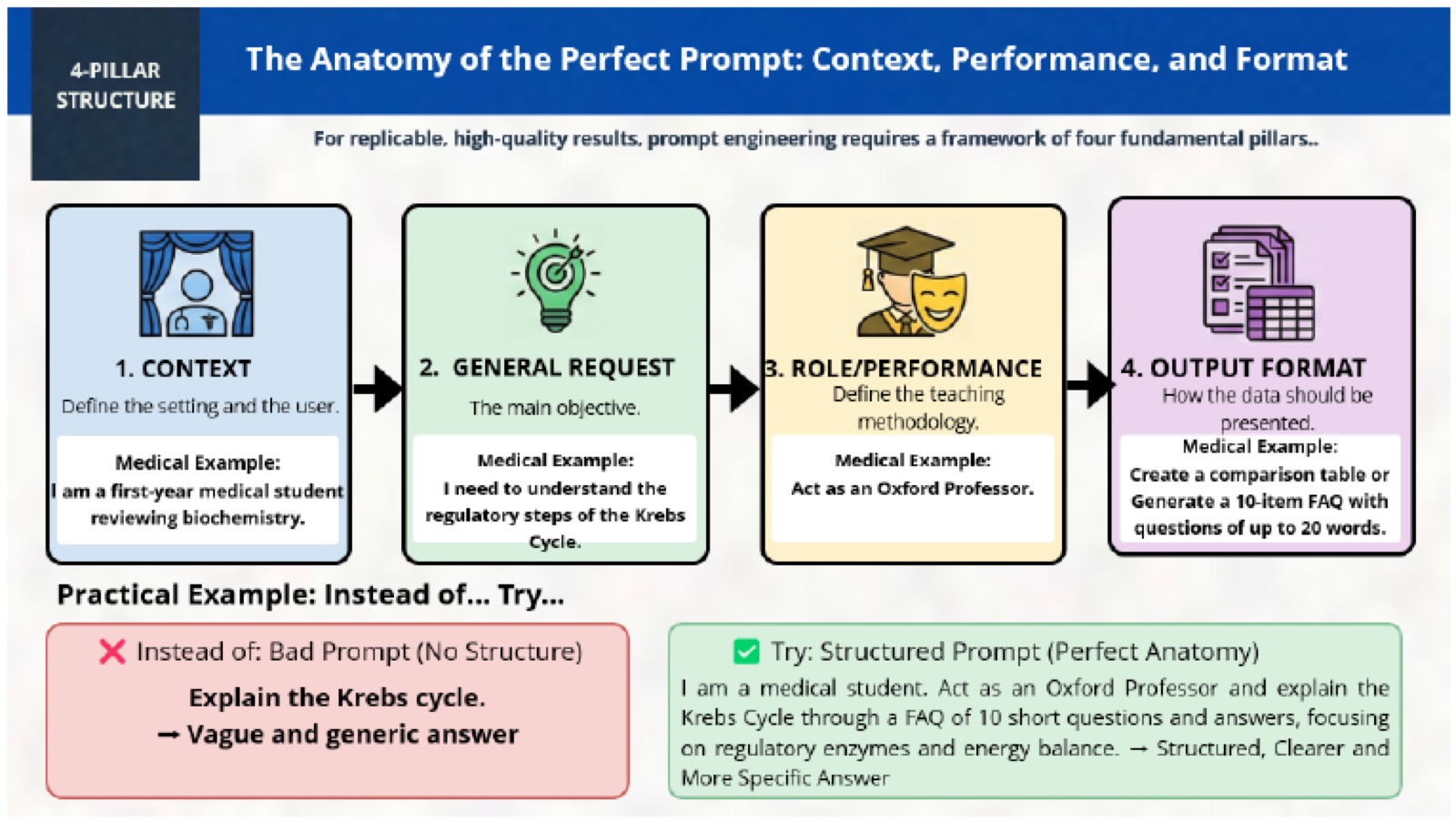
Generative Artificial Intelligence (AI) has become a tangible reality in medical education, yet many struggle to interact effectively with these models. This editorial introduces Prompt Engineering as the modern “digital stethoscope”-a systematic approach to maximize AI potential. A structured prompt relies on four pillars (Context, Request, Persona, Format) and advances through four levels of complexity. Strategies like instructing the AI to “think step by step” mitigate logical errors in clinical tasks. However, users must remain vigilant against AI “hallucinations” and phantom citations by using verified databases. Ultimately, while AI processes vast data, human clinical judgment remains the irreplaceable filter for patient safety.
ARTICLE HIGHLIGHTS: The anatomy of a “perfect prompt” rests on four fundamental pillars.
• The most clinically relevant impact of advanced prompting is the mitigation of catastrophic errors.
• Ultimately, Prompt Engineering is more than a technical skill; it is a new pedagogy.
• The success of medical education lies not merely in the transfer of facts, but in forging a mind capable of interrogating reality with precision.
Pancreatoduodenectomy is a technically-challenging surgical procedure. In experienced centers, the postoperative mortality is around 5% and postoperative complications remain high, ranging from 30 to 61%1,18. According to Torres et al., in 52 Brazilian centers, most of hepatopancreatobiliary surgeons (65.4%) performed only open conventional pancreatoduodenectomy in 201715. Robotic surgery has revolutionized minimally invasive surgical techniques, offering distinct advantages in various complex procedures, including pancreatoduodenectomy (Whipple procedure)1,18. It represents a significant advancement in the surgical management of various malignant and benign conditions affecting the head of the pancreas, duodenum, bile duct, and surrounding areas, especially for pancreatic head and periampullary cancer3. This complex procedure involves resecting the pancreas head, duodenum, bile duct, and part of the stomach, followed by the gastrointestinal tract reconstruction3,4,14. In pancreaticoduodenectomy, surgeon volume significantly affects outcomes, thus affecting mortality and morbidity rates, lengths of stay, and costs2. Tseng et al. showed that after 60 cases, the surgeon gained experience and improvement regarding blood loss, operative time, length of stay, and the achievement of negative margin resection16.
The robotic system provides surgeons with wristed instruments that mimic the movements of the human hand, but with greater precision and range of motion. This is particularly beneficial in the confined anatomical spaces of the pancreas and surrounding structures6. It also offers a three-dimensional, high-definition view of the operative field, allowing for better identification of critical anatomical landmarks and vascular structures1,6,17. This enhanced visualization facilitates meticulous dissection and reduces the risk of intraoperative complications1,18.
Robotic pancreatoduodenectomy (RPD) is safe and feasible, and in specialized centers, the procedure is associated with longer operative times and reduced intraoperative blood loss. In addition, perioperative pain scores are significantly lower with shorter lengths of stay with the robotic approach. Regarding postoperative complications, postoperative pancreatic fistula rates are similar for minimally invasive and open pancreaticoduodenectomy (OPD)13,16. A recent systematic review and meta-analyses by Lancellotti et al., including five studies with 12.984 patients, found that minimally invasive pancreatoduodenectomy is associated with a higher incidence of postoperative venous thromboembolism when compared to the open approach (total venous thromboembolism p<0.001; pulmonary embolism p=0.002; deep venous thrombosis p=0.004)7.
To date, oncological outcomes and survival are comparable between RPD and OPD. According to the current literature, RPD is either equivalent, superior, or inferior in certain aspects to OPD16. In approximately 15% of patients with pancreatic ductal adenocarcinoma, vascular resection (portal-mesenteric vein) is necessary3. Due to its complexity, occasional surgeons in low-volume centers without expertise in pancreatic surgery should not perform RPD.
The first OPD performed in Brazil was reported by Frederico Trigo Lopes in 1945 and is considered an important landmark in the country8. It was only in 2009 that the first RPD was performed at Hospital Israelita Albert Einstein in São Paulo9. Over the past 15 years, Brazil has seen a substantial increase in the adoption of robotic surgery, and it is estimated that approximately 140 thousand robotic procedures were performed across various surgical areas, including robotic pancreatoduodenectomies, reflecting the growing utilization of this advanced technique in managing pancreatic and periampullary diseases6,12. As of 2022, only 25.2% of the Brazilian population had private health insurance coverage, indicating that most robotic pancreatoduodenectomies occur in the private sector, where leading hospitals and medical institutions have embraced robotic surgery, supporting its integration into surgical practice5.
Developing cost-effective models and exploring public-private partnerships can help mitigate the financial barriers to adopting this technique16. However, even though the high cost of robotic systems and associated instruments (including the initial investment, maintenance, and the cost of disposable instruments used during each procedure) remains a significant barrier to widespread adoption, studies have shown that minimally invasive major pancreatic surgery entails higher intraoperative but similar overall index hospitalization costs, mainly due to reduced length of hospital stay2. This gap in research limits our understanding of the economic implications and potential benefits of robotic-assisted techniques for more complex pancreatic surgeries, highlighting the need for comprehensive studies to evaluate their cost-effectiveness and broader adoption11,18.
In the largest Brazilian series of 105 robotic pancreatic resections conducted in São Paulo from March 2018 to December 2019, 51 were pancreatoduodenectomies. Morbidity was reported in 23.8% of patients, with only one mortality. Additionally, three patients (2.8%) required conversion to open surgery. Among all patients, 24 developed pancreatic fistulas, which were treated conservatively with the late removal of the pancreatic drain. However, these data come from surgeons with expertise in pancreatic and minimally invasive surgery10.
And last, but not least, the complexity of robotic procedure requires extensive training and experience6,18. Surgeons must undergo rigorous training to achieve proficiency in robotic pancreatoduodenectomy, which can be time-consuming and resource-intensive. The steep learning curve can initially result in longer operative time and potentially higher rates of complications, including mortality, as surgeons gain experience. Establishing comprehensive training programs and centers of excellence has been crucial in building a skilled workforce capable of performing robotic pancreatoduodenectomy. Ongoing education and hands-on experience are vital for maintaining and enhancing surgical skills1,17,18.
The experience of over 15 years with robotic pancreatoduodenectomy in Brazil has demonstrated the significant potential of this advanced surgical technique. While challenges related to cost, accessibility, and the learning curve remain, the benefits of enhanced precision, reduced complications, and improved recovery times make robotic pancreatoduodenectomy a promising option for the management of pancreatic and periampullary diseases. Continued investment in training, research, and technological innovation will be essential for realizing the full potential of robotic surgery and expanding its impact on patient care in Brazil7,8,10
Molecular medicine opened new horizons in understanding disease mechanisms and discovering target interventions. The wider availability of DNA and RNA sequencing, immunohistochemical analysis, proteomics, and other molecular tests changed how physicians manage diseases. The gastric cancer molecular classification proposed by The Cancer Genome Atlas Program divides gastric adenocarcinomas into four subtypes. However, the available targets and/or immunotherapies approved for clinical use seem to be dissociated from these molecular subtypes. Until a more reliable interpretation of the stupendous amount of data provided by the molecular classifications is presented, the clinical guidelines will rely on available actionable targets and approved therapies to guide clinicians in conducting cancer management in the era of molecular therapies.
Professor Joaquim José Gama-Rodrigues was born in Cruzeiro, state of São Paulo, Brazil, on December 2, 1935. Following his family's example and vocation, he pursued education in public schools, initially in Guaratinguetá, near his hometown, and later attended Colégio Estadual Presidente Roosevelt in São Paulo city.
He successfully passed the entrance exam and immediately gained admission to the Faculty of Medicine of Universidade de São Paulo (FMUSP) in 1954, ranking 38th among his peers. He never left until compulsory retirement, at age 70, in 2005.
His vocation has always been the incessant pursuit for knowledge, following the example set by his mentors, to increasingly expand his expertise. This drive led him to undertake scientific initiation at the Surgical Technique Department, where his efforts culminated in a study published in an indexed journal while he was still a student.
He consistently prioritized sharing knowledge with his peers, leading him to assume roles such as the speaker of his class and student representative at the National Union of Students (UNE) and State Union of Students (UEE) on numerous occasions. This associative activity persisted throughout his academic journey, initially as a representative of physicians and later as a representative of full professors and associates of FMUSP.
In 1960, he graduated and achieved 1st place in the Residency in General Surgery exam, at the Hospital das Clínicas of FMUSP. His excellence was further recognized when he was elected chief resident by his peers. At that time, he held a seat on the Administrative Committee, and actively contributed to the laying of the "foundation stone" for the building that accommodates hospital residents.
In this nurturing environment, he found himself drawn to morphological subjects, an area in which the character and intellectual discipline of Renato Locchi's inspiring personality stood out. His interest in surgery was quickly piqued, at which point he received invaluable encouragement and support from extraordinary mentors at the onset of his journey. The esteemed names of Alípio Corrêa Netto and Arrigo Raia deserve mention. As a recent graduate, he also benefited from the valuable guidance of Antonio Barros de Ulhôa Cintra and Carlos da Silva Lacaz, among many other luminaries in the field. Such an exceptional experience prompted him to contemplate the need to always be prepared to fulfill the institutional requirements that evolve within work communities over time. He realized that continuous personal improvement was an inevitable obligation in this pursuit.
He obtained doctorate in medicine with the thesis entitled "Motor changes of the esophagus in patients with esophageal varices caused by schistosomiasic portal hypertension" in 19721; the title of Associate Professor with the thesis entitled "Sliding Hiatal Hernia. Esophageal Fundogastropexy Associated with Hiatoplasty, Clinical, Morphological and Functional Assessment" in 19742; and the title of Full Professor of Surgery in the Department of Gastroenterology of FMUSP, in 2002, through a public tender.
He held the position of Head of the Department of Gastroenterology and Surgery at FMUSP and Head of the Stomach and Small Intestine Surgery Service at the Hospital das Clínicas of the Universidade de São Paulo. Additionally, he was a full member of the Board of Directors of USP from 1990 until 2005.
In his associative endeavors, he served as a founding member and president of the Brazilian College of Digestive Surgery, 2001–2002. He was also the creator and founding member, along with several colleagues, of the Brazilian Gastric Cancer Association, for which he was elected as the association's first president, from 1999 to 2001, and again for the 2004–2006 biennium. His contributions led to the presidency of the International Gastric Cancer Association (IGCA) from 2007 to 2009. Furthermore, he served as the director of the Angelita and Joaquim Gama Institute for Research and Teaching in the Digestive System and is a founding member of the Brazilian Association for the Prevention of Bowel Cancer (ABRAPRECI) since 2004.
He is an honorary member of the American College of Surgeons, a title bestowed upon him in 2006, as well as an honorary member of the Brazilian College of Surgeons, awarded in 2018.
He participated in the organization of numerous medical congresses, notably serving as the president of the 7th World Gastric Cancer Congress held in São Paulo, in May 2007. In addition, he is president of the Organizing Committee of the International Rectal Cancer Forum (Fórum Internacional de Câncer do Reto – FICARE), a biennial event held in São Paulo since 2007. He has made significant contributions through important publications on this topic3,4.
He has authored 251 scientific articles indexed in PubMed and boasts an impressive H-index of 54. He has held various positions in esteemed scientific journals, including member of the Editorial Committee of the World Journal of Surgery, Hepatogastroenterology, Acta Cirúrgica Brasileira, Arquivos Brasileiros de Cirurgia Digestiva, Arquivos de Gastroenterologia, and of Gastric Cancer; the first being based in the USA, the last at IGCA in Tokyo, and the others in São Paulo.
It is noteworthy to mention that Professor José Joaquim Gama-Rodrigues was a mentor and motivator for doctors, disciples, and researchers alike. He actively fostered opportunities and supported the career development of his peers, colleagues, and residents, participating in the creation of the Endoscopy Service at the Hospital das Clínicas of FMUSP. As director of the Stomach and Small Intestine Service, he headed the "GENOMA" project, a groundbreaking initiative aimed at advancing the study of Gastric Cancer. This project not only modernized and standardized gastric cancer surgery in Brazil and Latin America but also facilitated international collaborations, particularly with Japan and other international centers5–7. As a result of his efforts, this activity allowed him to bring the 7th World Gastric Cancer Congress to our country in 2007, laying the foundation for its return in 2015.
In collaboration with Prof. Arrigo Raia, Prof. Angelita Habr-Gama, and Prof. Henrique Walter Pinotti, he played a role in the inception of the renowned GASTRÃO, the foremost Brazilian event in the realm of Digestive System Surgery and Gastroenterology, which has recently celebrated 50 years of continuous operation.
Building upon this foundation, in 1988, along with Prof. Henrique Walter Pinotti and other collaborators, he created the Brazilian College of Digestive Surgery. Six years later, in 1994, their efforts culminated in the formation of the medical specialty Digestive System Surgery. His performance was fundamental at the Conselho Federal de Medicina plenary session, for the acceptance and implementation of that specialty which has since become a cornerstone of medical practice in Brazil.
The Professor was the recipient of numerous accolades and distinctions, renowned for his excellence as a surgical educator and researcher. He was bestowed the title of Honored Professor by three graduating classes at FMUSP. He received honors from the Lusíada Academy of Sciences, Letters and Arts of São Paulo, where he was later appointed as an honorary member. In 2010, he was honored with the Order of Merit of Infante Dom Henrique and became an esteemed honorary member of Casa de Portugal in São Paulo.
Professor Joaquim José Gama-Rodrigues epitomizes the essence of a true PROFESSOR, embodying the qualities of a compassionate "human being," "doctor," "surgeon," and "teacher," leaving behind a rich cultural and humanistic legacy that serves as a beacon of guidance for generations to come



Developed by Surya MKT