

Surgical site infections represent a significant complication after emergency laparotomy, contributing to increased morbidity, mortality, and healthcare costs. Negative pressure wound therapy (NPWT) may reduce the incidence of surgical site infections; however, evidence from randomized controlled trials remains inconsistent.
To present a systematic review and meta-analysis, comparing NPWT with conventional dressings in emergency laparotomies.
Systematic searches were conducted according to the Cochrane Handbook and reported according to the PRISMA 2020 guidelines. The PubMed, Embase, and Cochrane CENTRAL databases were searched since their inception, using terms related to emergency laparotomy, NPWT, and conventional dressings. The reference lists of included studies were manually examined to identify additional eligible trials. Only randomized controlled trials that compared NPWT with conventional dressings in emergency abdominal surgeries and that reported surgical site infection rates or other clinical outcomes were included. The primary outcome was the incidence of surgical site infection. Secondary outcomes included wound dehiscence, seroma formation, length of hospital stay, and 30-day mortality.
Eight randomized controlled trials, totaling 1,377 patients (707 in the NPWT group and 670 in the conventional dressing group), were included. NPWT significantly reduced the risk of surgical site infection (risk ratio [RR] 0.43; 95% confidence interval [CI] 0.26–0.73; p=0.002; heterogeneity [I2]=76%) and wound dehiscence (RR 0.32; 95%CI 0.18–0.58; p=0.0002). No significant differences were observed regarding seroma formation (RR 0.59; 95%CI 0.34–1.01; p=0.05), length of hospital stay (mean difference [MD] -0.39 days; 95%CI -1.15– 0.36; p=0.92) or mortality (RR 0.96; 95%CI 0.55–1.68; p=0.88).
This systematic review and meta-analysis of randomized clinical trials suggests that NPWT reduces the incidence of surgical site infection and wound dehiscence after emergency laparotomy, supporting its use in high-risk patients.
Hepatocellular carcinoma is a major cause of cancer-related mortality and represents a growing public health challenge.
To develop multidisciplinary evidence-based recommendations for the prevention and early detection of hepatocellular carcinoma.
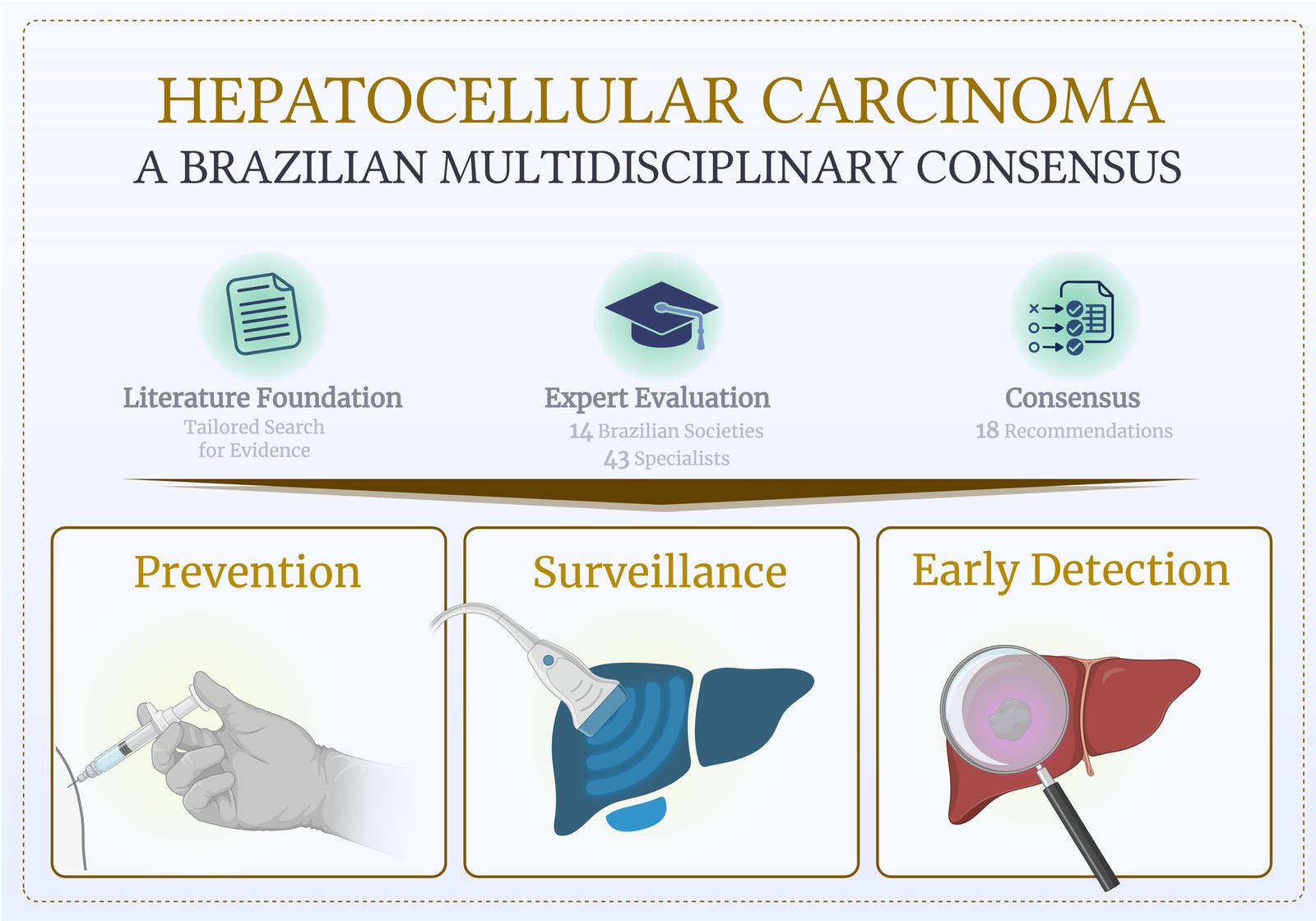
This consensus was coordinated by the Brazilian Society of Surgical Oncology, with the participation of 13 additional national societies. A steering committee defined the key clinical questions addressing prevention, surveillance, and early detection strategies. Recommendation statements were informed by a comprehensive, non-systematic review of the literature conducted using PubMed, Scopus, and the Cochrane Library.
Eighteen recommendations reached consensus, covering three main domains: 1. Primary prevention, including HBV vaccination, timely antiviral therapy for viral hepatitis, and lifestyle interventions for metabolic dysfunction. 2. Secondary prevention, outlining risk-based surveillance strategies for patients with advanced fibrosis or cirrhosis due to hepatitis B virus, hepatitis C virus, or metabolic dysfunction-associated steatotic liver disease. 3. Operational standards for surveillance, emphasizing ultrasound as the cornerstone of monitoring, the importance of structured reporting, management of small nodules, and the selective use of cross-sectional imaging.
These multidisciplinary recommendations provide practical, adaptable guidance for the prevention, surveillance, and early detection of hepatocellular carcinoma. This guidance document aims to reduce the burden of hepatocellular carcinoma and support better clinical outcomes across diverse healthcare settings.
Postgraduate education is essential for training highly qualified health professionals; however, there is a lack of studies in Brazil evaluating career outcomes of gastroenterology alumni.
To analyze the sociodemographic profile, academic background, career outcomes, and perceived impact of postgraduate training in Sciences, more specifically in Gastroenterology, comparing physicians and non-physicians, as well as physicians with surgical versus clinical training.
A cross-sectional study was conducted among alumni who completed master’s and doctoral degrees from 2012 to 2024 at Universidade de São Paulo School of Medicine. A 47-item questionnaire collected data on demographics, training, professional practice, academic productivity, and program impact. Statistical comparisons were performed using ꭓ2 or Fisher’s exact tests and the Mann-Whitney U test (p<0.05).
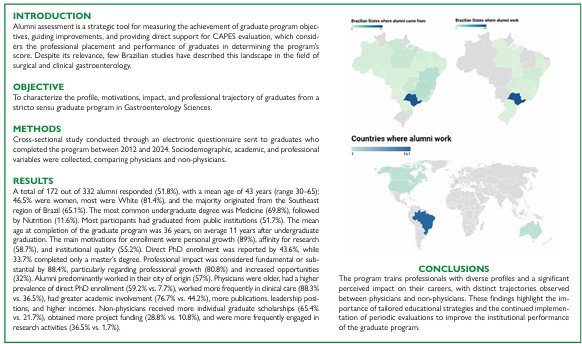
Of the 332 eligible alumni, 172 completed the questionnaire (51.8%). The mean age was 43 years; 53.5% were men, and 69.8% were physicians. Postgraduate training was considered fundamental by 51.2% and highly impactful by 37.2, and 74.4% would certainly pursue it again. Physicians were older, had higher scientific output, and more frequently held academic and leadership positions. Non-physicians were predominantly women, received a higher number of scholarships, and more frequently reported positive career changes. Among physicians, those with surgical training had higher income, more academic titles, and were more often based in São Paulo, whereas those with clinical training reported more professional opportunities.
Postgraduate training in Sciences in the field of Gastroenterology, had a relevant positive impact on academic and professional development, with differences according to baseline training and professional profile.
The increase in life expectancy and the development of comorbidities bring a higher rate of complications and mortality in the postoperative period of surgical procedures in general. Among these associations, elective colorectal surgery and acute kidney injury are notable.
To analyze risk factors associated with acute kidney injury in the postoperative period of elective colorectal surgeries in patients over 65 years of age. Additionally, to outline the epidemiological, clinical-surgical, and laboratory profile of the study population.
A clinical, observational, longitudinal, prospective, and analytical study with a quantitative approach involving 30 patients from January 2023 to April 2024. Data analysis included pre, intra, and post-operative periods, with renal function assessment on the 3rd and 5th days after surgery.
The overall mean age was 70.4 years, 53.3% were female, 46.6% were smokers or former smokers, 63.3% had systemic arterial hypertension, and 23.3% had diabetes mellitus. Ten patients developed acute kidney injury in the postoperative period. The use of angiotensin-converting enzyme inhibitors and postoperative diuresis were significantly associated variables (p=0.039 and 0.034, respectively). The diuresis cutoff value to foretell non-progression to acute kidney injury was 0.5 mL/kg/h, with an accuracy of 88%, sensitivity of 100%, specificity of 77.78%, positive predictive value of 86.67%, and negative predictive value of 100%.
In elderly patients undergoing elective colorectal surgery for oncological treatment, the incidence of acute kidney injury was high.
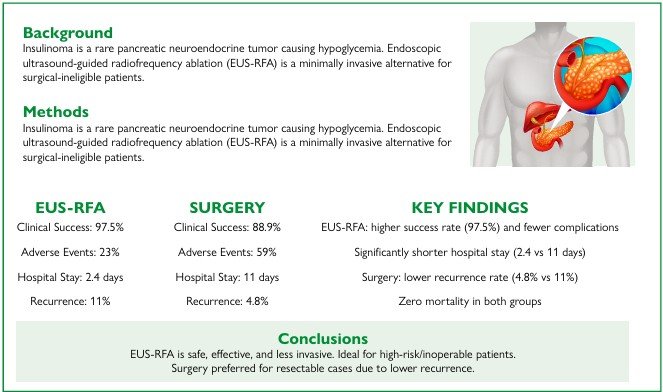
Insulinoma is a rare pancreatic neuroendocrine tumor (pNET) arising from beta cells, leading to excessive insulin secretion and life-threatening hypoglycemia. While surgical resection remains the gold standard, endoscopic ultrasound-guided radiofrequency ablation (EUS-RFA) has emerged as a minimally invasive alternative, particularly for patients unfit for surgery.
A meta-analysis was performed according to PRISMA (Preferred Reporting Items for Systematic Reviews and Meta-Analysis) guidelines to compare the efficacy and safety of EUS-RFA and surgery for pancreatic insulinomas.
Systematic searches were conducted in PubMed, Cochrane Library, Embase, and Scopus, using MeSH terms related to insulinoma, RFA, and surgery. Eligible studies included cohort studies and case series reporting clinical outcomes, adverse events, recurrence rates, and hospitalization. Statistical analyses were performed with Comprehensive Meta-analysis Software and RevMan 5.
A total of 20 studies were included, comprising 142 patients treated with EUS-RFA and 249 with surgery. Clinical success was higher in the EUS-RFA group (97.5%) compared with surgery (88.9%). Patients undergoing EUS-RFA experienced fewer complications (23 vs. 59%), shorter hospital stays (mean 2.4 vs. 11 days), and zero procedure-related mortality. However, recurrence rates were greater with EUS-RFA (11%) than with surgery (4.8%). No significant differences were found in overall survival during follow-up.
EUS-RFA is a safe, effective, and less invasive option for managing pancreatic insulinomas, ensuring rapid recovery and fewer complications. Nevertheless, its higher recurrence rate highlights the importance of patient selection and strict follow-up. Surgery remains the treatment of choice in resectable cases, while EUS-RFA represents a valuable alternative in high-risk or inoperable patients.
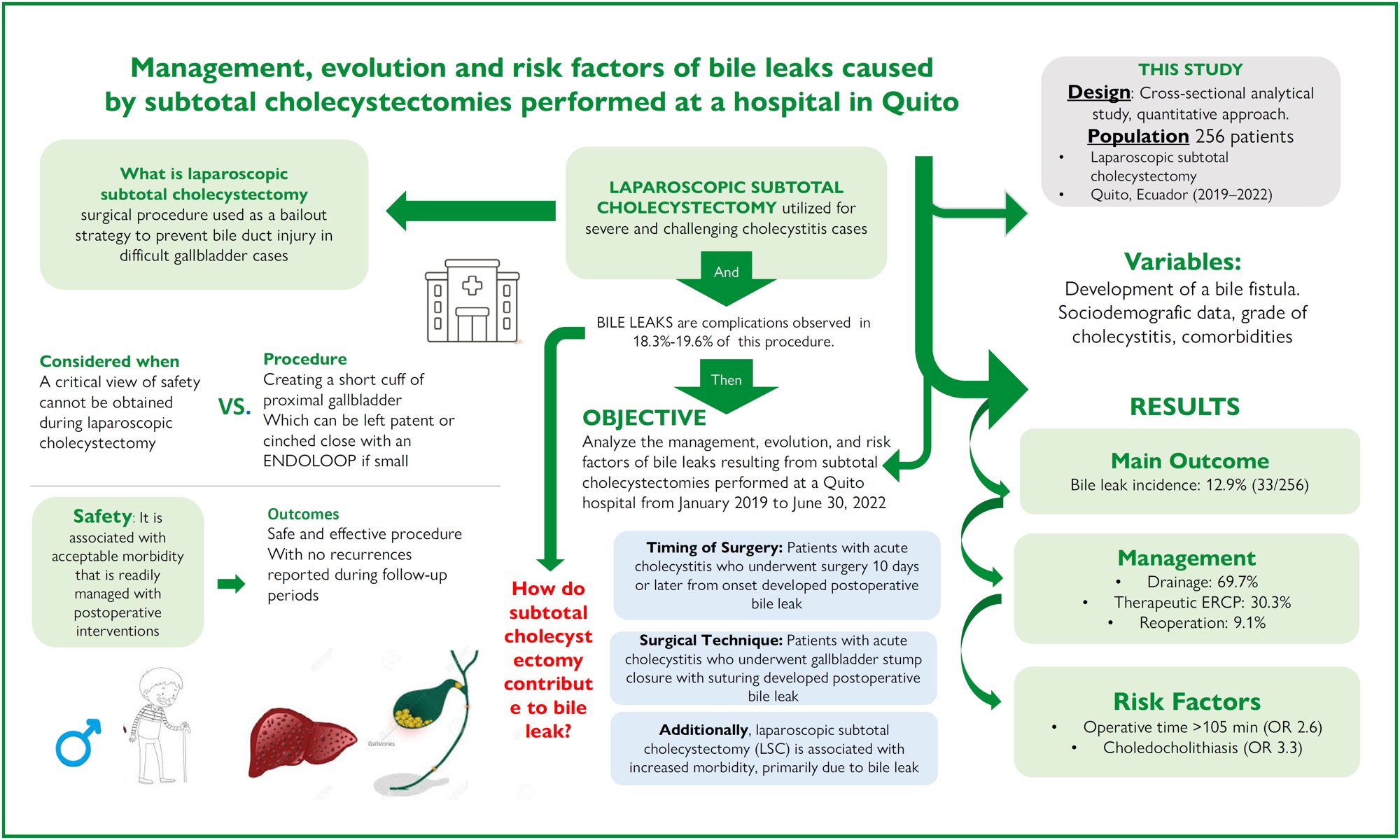
Laparoscopic subtotal cholecystectomy is indicated for severe cholecystitis; however, it may lead to complications, including postoperative bile fistulas.
To evaluate the management, evolution, and risk factors associated with bile fistulas after laparoscopic subtotal cholecystectomy in a hospital in Quito from January 2019 to June 2022.
A cross-sectional analytical study with a quantitative approach was conducted. A retrospective review of medical records of patients who underwent laparoscopic subtotal cholecystectomy (n=256) was performed. The dependent variable was the occurrence of bile fistulas, while independent variables included sociodemographic data (age, sex) and clinical factors such as comorbidities, nutritional status, cholecystitis severity (Parkland classification), surgical planning, type of cholecystectomy, anesthetic risk (American Society of Anesthesiologists; ASA I–IV), surgical time, intraoperative complications, time of fistula onset, evolution, and postoperative complications.
The incidence of postoperative fistulas was 12.9% (n=33). Management strategies included drainage (69.7%) and endoscopic retrograde cholangiopancreatography (ERCP) (30.3%). Spontaneous closure occurred in 60.6%, while 30.3% required therapeutic ERCP and 9.1% needed reoperation. Significant risk factors included surgical time >105 minutes (relative risk [RR]: 2.06; 95% confidence interval [CI] 1.04–4.08), type A cholecystectomy (RR 2.19; 95%CI 1.05–4.57), and choledocholithiasis (RR 2.5; 95%CI 1.34–4.67). Logistic regression confirmed surgical time (odds ratio [OR]: 2.6; 95%CI 1.2–5.8) and choledocholithiasis (OR 3.3; 95%CI 1.4–3.9) as significant predictors (p<0.05).
The incidence of postoperative fistulas observed was comparable to previous reports in the literature, highlighting the importance of early identification and appropriate management.
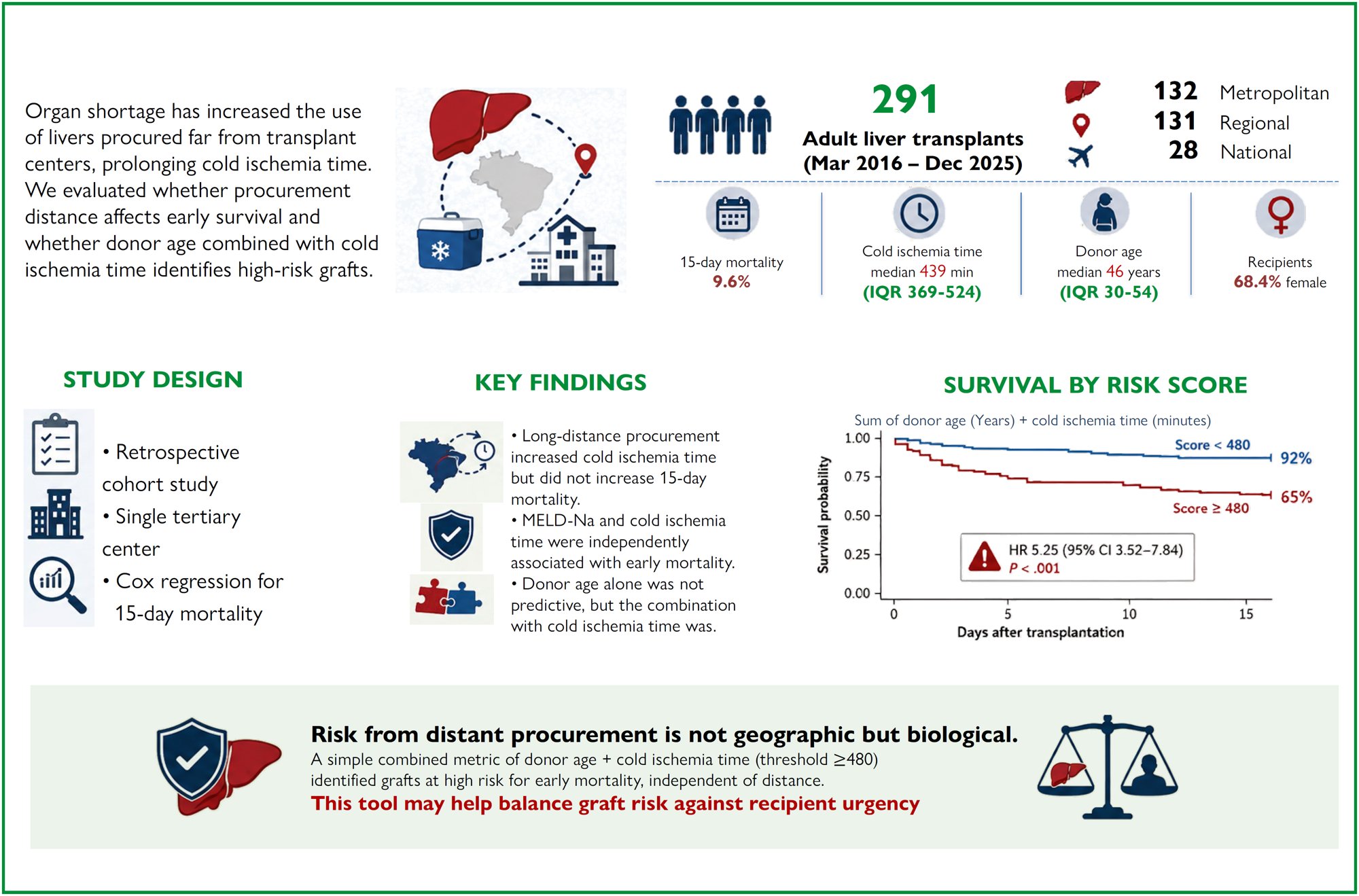
The increasing need to expand the donor pool has led to greater utilization of liver grafts procured at a distance from transplant centers, inevitably prolonging cold ischemia time. Whether long-distance procurement independently affects early outcomes or whether risk is primarily driven by donor-related factors remains uncertain.
We evaluated the impact of procurement distance on early post-transplant survival and investigated whether the combined effect of donor age and cold ischemia time could define a clinically meaningful risk threshold.
We performed a retrospective cohort study of adult liver transplant recipients from March 2016 to December 2025 at a single tertiary transplant center. Donor, recipient, and procurement variables were analyzed according to procurement location. Early mortality was assessed using Kaplan–Meier analysis and Cox proportional hazards modeling. Among 291 transplants, long-distance procurement was associated with significantly longer cold ischemia time but not with increased 15-day mortality. In multivariable analysis, recipient severity (Model for End-stage Liver Disease-Sodium score) and cold ischemia time were independently associated with early mortality, whereas procurement location and donor age alone were not. A composite variable defined by the sum of donor age and cold ischemia time identified a threshold (≥480) associated with significantly reduced early survival, conferring more than a fivefold increase in 15-day mortality independent of procurement distance.
These findings suggest that the risk associated with distant procurement is not geographic but biological, reflecting the interaction between donor susceptibility and ischemic burden. A simple combined metric may help clinicians balance graft-related risks against recipient urgency when evaluating marginal offers.
Pancreatic ductal adenocarcinoma (PDAC) is the most common form of pancreatic cancer and remains the most lethal malignancy of the digestive system. Despite recent advances, surgical treatment remains the only potentially curative option. Most patients are diagnosed with locally advanced or disseminated disease, and chemotherapy is the only indicated treatment. Pancreatic resection rates in centers that do not perform vascular resection are around 15–20% of diagnosed cases, while in specialized centers with vascular expertise, they may reach 30–45%. Ablative therapies have been investigated as local alternatives for unresectable tumors. Radiofrequency ablation (RFA) has proven efficacy in the treatment of hepatic neoplasms, and has recently been explored in PDAC. Endoscopic ultrasound-guided radiofrequency ablation (EUS-RFA) represents a minimally invasive alternative for thermal ablation of pancreatic tumors. Early experience suggests that may serve as a palliative modality for pain or obstruction control, and to facilitate chemotherapy. However, this treatment is considered experimental and requires procedural standardization. Careful patient selection is essential, prioritizing cases without metastatic spread, with tumors accessible by EUS and without extensive vascular invasion.
Knowledge of the cystic artery and its variations is essential to perform safe cholecystectomies. The cystic artery originates from the right hepatic artery, passing posterior to the common hepatic duct, anterior to the cystic duct, and branching into two branches at the neck of the gallbladder. However, variations in position, size, and relationship with adjacent structures are common.
This article presents a literature review regarding cystic artery variations and their frequency during cholecystectomies.
The articles selected for this review were chosen from the PubMed and SciELO databases. The standardized descriptors used were anatomic variation and cholecystectomy. These were chosen using the “Medical Subject Headings” and combined with the Boolean operator AND and the non-standard descriptor cystic artery.
It was found in 54.5% of the studies that the anatomical pattern of the cystic artery was the most frequent type. A different origin from the standard was cited in 63.6% of the articles. Double irrigation of the gallbladder was found in 59.1%. In 36.4%, the cystic artery was anterior to the common hepatic duct or the cystic duct. Cystic arteries outside Calot’s triangle were found in 36.4%. Short cystic arteries were found in 13.6%. The absence or non-identification of the artery was reported in 9.1%.
Variations of the cystic artery are common and are frequently reported. One aspect of a safe cholecystectomy is anatomical knowledge and its possible variations. Thus, surgeons must be familiar with this point in order to reduce vascular and biliary injuries.
Deaths related to colorectal cancer are generally associated with its metastases that affect the liver (50%) through the hematogenous route. Approximately 20-25% of these patients already have synchronous metastases in the liver at the time of primary tumor diagnosis. In others, liver metastases will occur during the course of the disease and are called metachronous. Metachronous metastases are believed to have a better prognosis; however, 20-25% of metastatic cases can be resected during the course of the disease. There is a lack of consensus on the diagnostic time interval for metastases to be considered metachronous in the consulted literature. Surgical treatment of metastases and lymph nodes is indicated, and extrahepatic neoplastic disease must be carefully evaluated. Liver transplantation can benefit the patient, should be evaluated, and is indicated in some special situations.




Developed by Surya MKT