

Solid pseudopapillary neoplasm of the pancreas is an uncommon pancreatic tumor, which is more frequent in young adult women. Familial adenomatous polyposis is a genetic condition associated with colorectal cancer that also increases the risk of developing other tumors as well.
The aim of this study was to discuss the association of familial adenomatous polyposis with solid pseudopapillary neoplasm of the pancreas, which is very rare.
We report two cases of patients with familial adenomatous polyposis who developed solid pseudopapillary neoplasm of the pancreas of the pancreas and were submitted to laparoscopic pancreatic resections with splenic preservation (one male and one female).
ß-catenin and Wnt signaling pathways have been found to play an important role in the tumorigenesis of solid pseudopapillary neoplasm of the pancreas, and their constitutive activation due to adenomatous polyposis coli gene inactivation in familial adenomatous polyposis may explain the relationship between familial adenomatous polyposis and solid pseudopapillary neoplasm of the pancreas.
Colonic resection must be prioritized, and a minimally invasive approach is preferred to minimize the risk of developing desmoid tumor. Pancreatic resection usually does not require extensive lymphadenectomy for solid pseudopapillary neoplasm of the pancreas, and splenic preservation is feasible.
Aggressive fibromatosis, also known as desmoid tumor (DT), is a locally aggressive myofibroblastic neoplasm originating from deep soft tissues, characterized by an infiltrative growth pattern with a tendency for local recurrence. DTs account for 0.03% of all neoplasms, and cases associated with familial adenomatous polyposis (FAP) account for 5–15% of DTs.
The aim of this study was to report the prevalence of DTs in patients operated on for FAP, describe the epidemiological profile, and evaluate the risk factors for tumor development, treatments performed, associated complications, and follow-up.
This retrospective study assessed the medical records of patients with FAP who underwent surgery between 1990 and 2021 and developed DTs during follow-up.
In the study period, 147 patients with FAP were operated on; of these, 97 underwent total proctocolectomy with ileal-pouch anal anastomosis, 33 underwent total colectomy with ileorectal anastomosis (IRA), 14 underwent total proctocolectomy with terminal ileostomy, and three underwent total colectomy with partial proctectomy and low IRA using an ileal-pouch. A total of 26 patients (17.7%) developed DT; most were female (61.5%), were White (73.1%), and had a family history (84.6%). The most frequent complications were intestinal and ureteral obstructions. Long-term follow-up showed that six patients were free of disease, 14 were stable and undergoing drug therapy, four died due to complications of the disease, and two were lost to follow-up.
The prevalence of DT tumor was relatively high and more commonly observed in patients with a family history of the tumor. The disease presented high rates of morbidity and mortality.
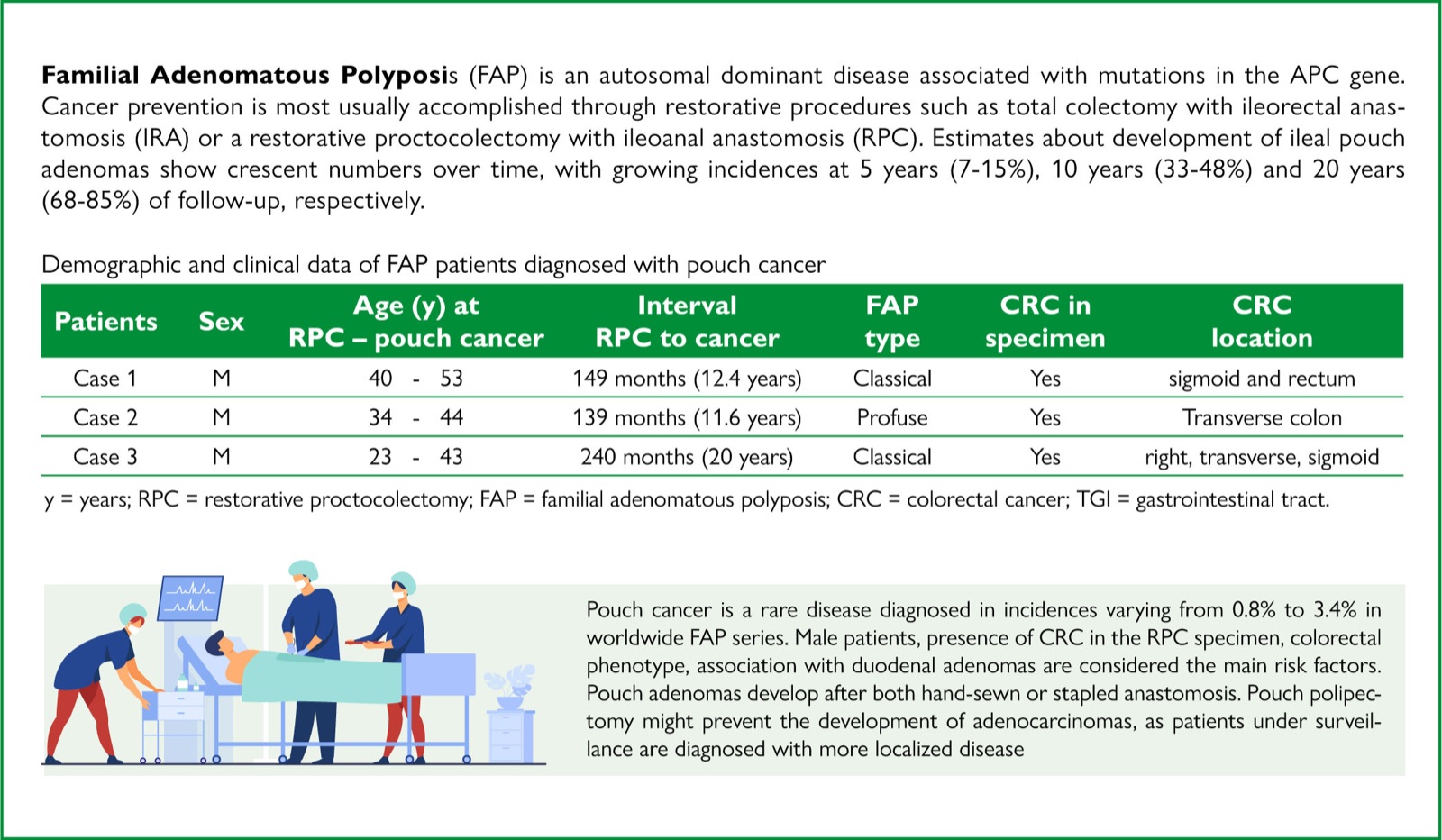
Development of pouch cancer is a great challenge to both surgeons and patients with familial adenomatous polyposis (FAP) after restorative proctocolectomy (RPC).
We aimed to present our experience with pouch cancer diagnosis and review literature data regarding incidence and associated risk factors.
This retrospective study enrolled FAP patients undergoing RPC between 1981 and 2023 in our academic institution. It included only J-pouch stapled patients with at least three years of follow-up. Patients’ demographics and disease features were retrieved.
After excluding seven patients, we selected 87 RPC, and three cases (3.4%) of pouch cancer were identified. They were diagnosed in three men aged 23–40 years at RPC and 41–62 years at cancer diagnosis. Interval from RPC to pouch cancer diagnosis varied from 11.6 to 20 years (average 14.6 years). All patients had colorectal cancers (CRC) detected in the specimen from the index surgery, two of them with multicenter lesions. A brief review of the literature series showed that pouch cancer has been detected in incidences ranging from 0.8 to 3.4%. Male sex, CRC in the RPC specimen, pouch phenotype during follow-up and an association with duodenal adenomas are considered risk factors.
Pouch cancer is a rare event associated with specific risk factors. After RPC, all patients should undergo endoscopic surveillance, with special attention to those who develop an aggressive phenotype during the first decade of follow-up.




Developed by Surya MKT