

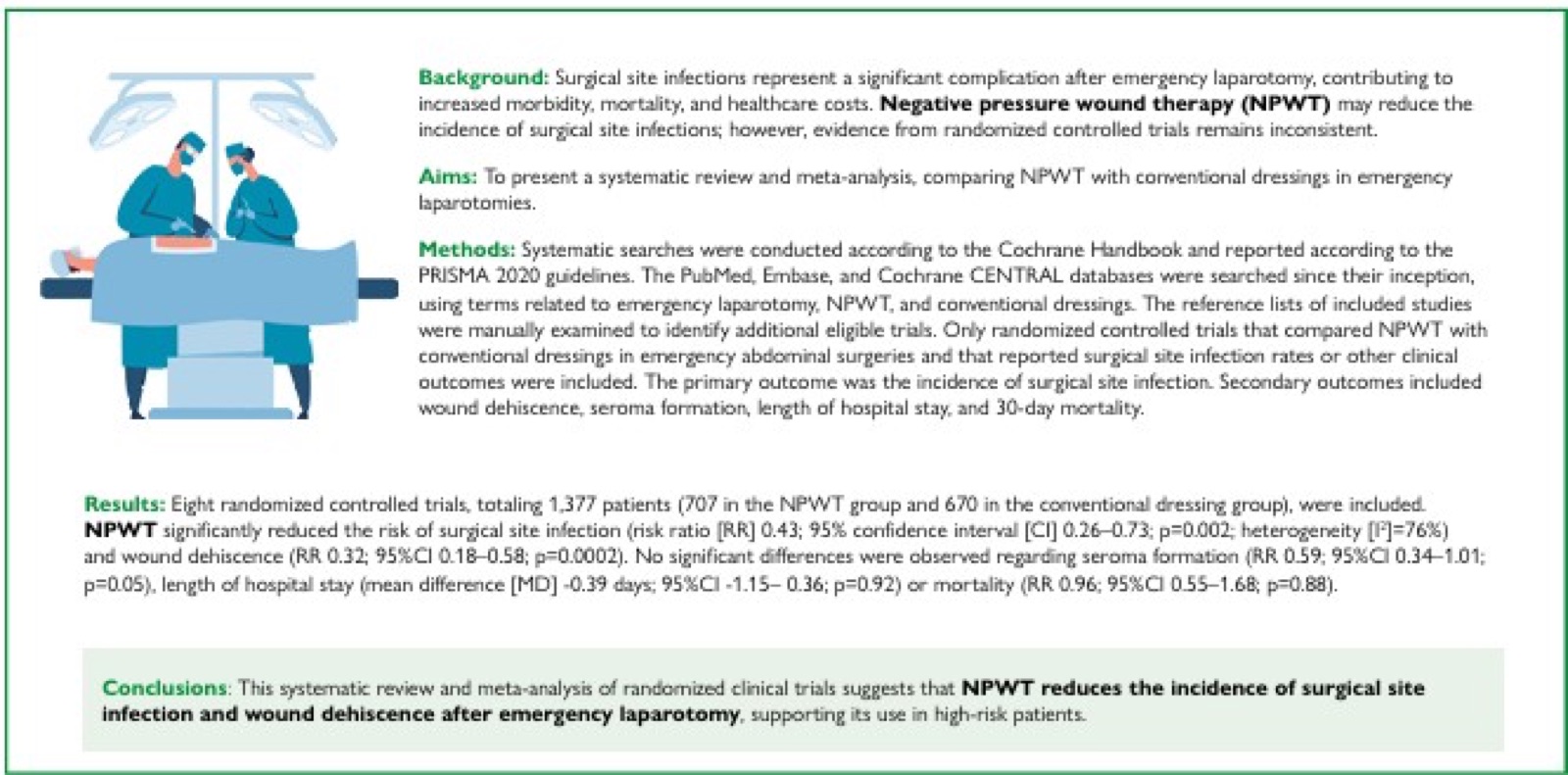
Surgical site infections represent a significant complication after emergency laparotomy, contributing to increased morbidity, mortality, and healthcare costs. Negative pressure wound therapy (NPWT) may reduce the incidence of surgical site infections; however, evidence from randomized controlled trials remains inconsistent.
To present a systematic review and meta-analysis, comparing NPWT with conventional dressings in emergency laparotomies.
Systematic searches were conducted according to the Cochrane Handbook and reported according to the PRISMA 2020 guidelines. The PubMed, Embase, and Cochrane CENTRAL databases were searched since their inception, using terms related to emergency laparotomy, NPWT, and conventional dressings. The reference lists of included studies were manually examined to identify additional eligible trials. Only randomized controlled trials that compared NPWT with conventional dressings in emergency abdominal surgeries and that reported surgical site infection rates or other clinical outcomes were included. The primary outcome was the incidence of surgical site infection. Secondary outcomes included wound dehiscence, seroma formation, length of hospital stay, and 30-day mortality.
Eight randomized controlled trials, totaling 1,377 patients (707 in the NPWT group and 670 in the conventional dressing group), were included. NPWT significantly reduced the risk of surgical site infection (risk ratio [RR] 0.43; 95% confidence interval [CI] 0.26–0.73; p=0.002; heterogeneity [I2]=76%) and wound dehiscence (RR 0.32; 95%CI 0.18–0.58; p=0.0002). No significant differences were observed regarding seroma formation (RR 0.59; 95%CI 0.34–1.01; p=0.05), length of hospital stay (mean difference [MD] -0.39 days; 95%CI -1.15– 0.36; p=0.92) or mortality (RR 0.96; 95%CI 0.55–1.68; p=0.88).
This systematic review and meta-analysis of randomized clinical trials suggests that NPWT reduces the incidence of surgical site infection and wound dehiscence after emergency laparotomy, supporting its use in high-risk patients.
It is known that elective inguinal hernioplasties are safe procedures, but in an emergency setting, they have higher rates of complications and hospital costs. Despite this, quantitative studies on the subject in Brazil are still scarce.
To evaluate the trend in hospitalization rates, hospital mortality, and costs for inguinal hernia in an emergency, regarding gender and age group.
This is a time series study with data from the Unified Health System (SUS), at the national level, from 2010 to 2019.
The overall hospitalization rate (p=0.007; b<0,02) in all age groups (p<0.005; b<0) in both genders indicated a decreasing trend. The general mortality rate in both genders and in most age groups showed an increasing trend (p<0.005), as well as the cost of hospitalization in all age groups of both genders.
Urgent hospitalization rates for inguinal hernia in Brazil have shown a steady or decreasing trend; however, hospital mortality and costs per hospitalization have demonstrated an increasing trend in recent years.




Developed by Surya MKT