

The effects of bariatric surgery in metabolically healthy obese (MHO) versus metabolically unhealthy obese (MUO) patients are underexplored in the literature.
The aim of the study was to compare the impact of bariatric surgery on weight loss, body composition, plasma biochemical parameters, and hepatic steatosis in MHO and MUO individuals.
Preoperative and 1-year postoperative medical records of 82 men and women aged 18–65 years, with body mass index >30 kg/m2, who underwent bariatric surgery from September 2021 to March 2023 were analyzed. MUO individuals were defined as those, metabolically unhealthy obese, with two metabolic syndrome risk factors, in preoperative data.
The prevalence of MHO and MUO individuals was 22 and 78%, respectively. Preoperative neck circumference and visceral adiposity index were higher in MUO individuals. Hepatic steatosis was the most common comorbidity in both groups. After 1 year, both groups demonstrated similar benefits from bariatric surgery in reducing body weight, adiposity, and anthropometric indices. Bariatric surgery also improved blood glucose, insulin sensitivity, and dyslipidemia in MUO individuals. However, 30% of MUO individuals presented with steatosis, compared to only 5.6% of MHO individuals. This outcome was accompanied by higher plasma levels of ferritin, alanine aminotransferase, and aspartate aminotransferase in MUO individuals.
Bariatric surgery provided similar benefits in body mass for MHO and MUO individuals. However, after 1 year, MUO individuals still exhibited elevated markers of inflammation, liver injury, and steatosis, suggesting greater residual metabolic vulnerability.
Obesity and type 2 diabetes mellitus are highly prevalent conditions with a significant public health impact, highlighting the need for effective management strategies. Bariatric surgery is widely recognized for promoting sustained weight loss and high rates of type 2 diabetes mellitus remission.
This study investigated the preoperative blood glucose response to a very low-calorie diet as a functional predictor of type 2 diabetes mellitus remission following Roux-en-Y gastric bypass.
198 participants who followed a very low-calorie diet (600 kcal/day) during the preoperative period were included, with glycemic response monitoring.
Complete remission of type 2 diabetes mellitus occurred in 66.7% of patients. Two years after surgery, patients with blood glucose levels below 143 mg/dL on the second day of the very low-calorie diet had a higher likelihood (over 70%) of achieving complete remission type 2 diabetes mellitus in the late postoperative period.
Preoperative capillary blood glucose levels demonstrated good specificity in predicting remissions. These findings reinforce the clinical utility of early glycemic control as a valuable indicator for predicting the success of surgical treatment for type 2 diabetes mellitus.
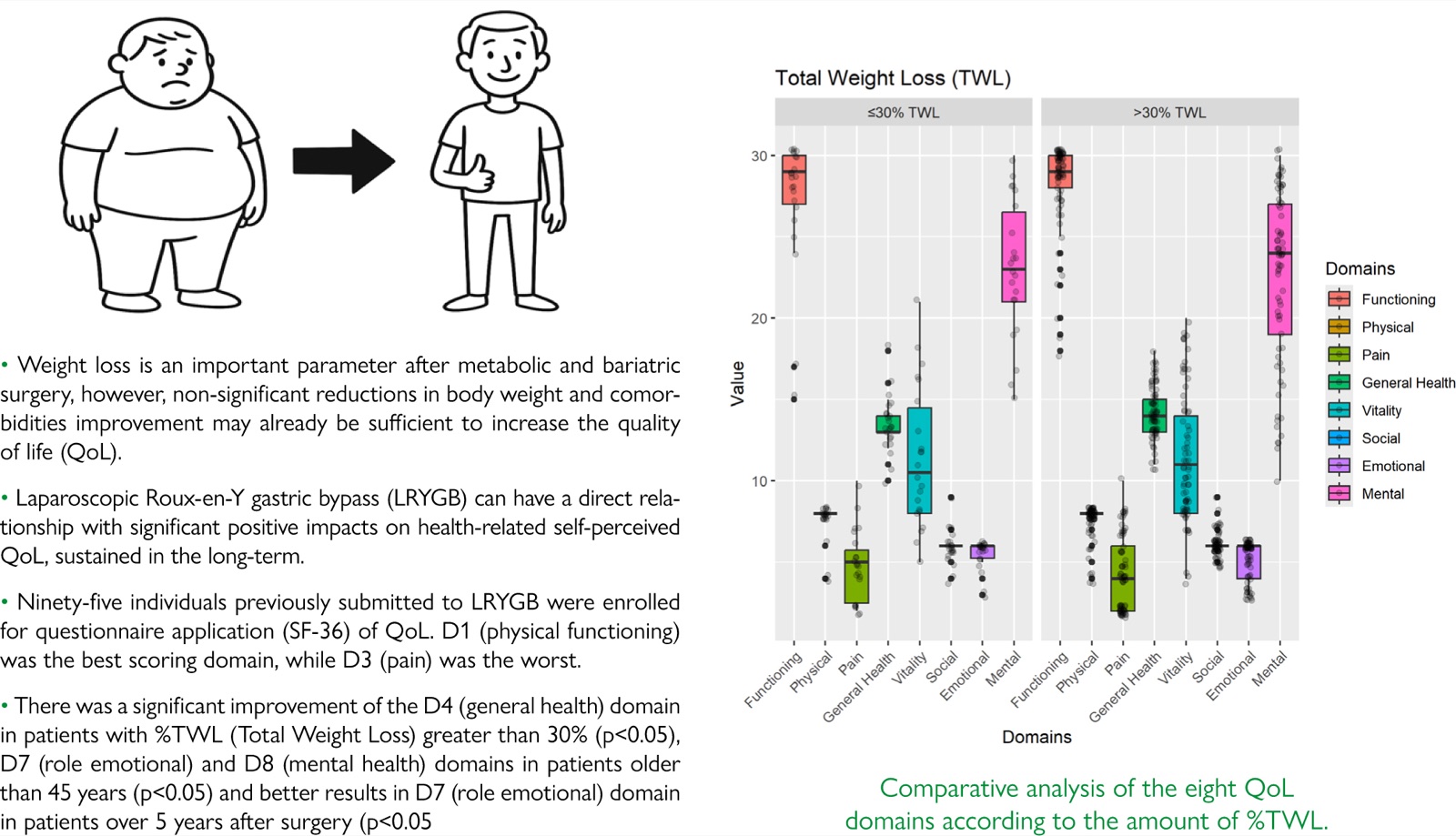
Weight loss (WL) is the most commonly used datum to measure the results of metabolic and bariatric surgery. The amount of WL is generally directly and proportionally associated with the improvement in quality of life (QoL), as the greater the former, the greater the perception of well-being.
To assess the relationship between the amount of weight lost after laparoscopic Roux-en-Y gastric bypass (LRYGB) and self-perceived improvement in quality of life (QoL).
The medical records of patients who underwent LRYGB between January 2017 and December 2019 with a minimum follow-up of 3 years were analyzed. The data obtained in the subgroups made up according to percentage of total weight loss (%TWL), age, and time elapsed since surgery were compared with the self-perceived QoL by the Short Form Survey 36 (SF-36) questionnaire.
A total of 95 individuals (71.6% women) with an average age of 45 years and an average postoperative (PO) follow-up of 61.1 months were enrolled. The mean pre- and postoperative weight was 114 kg and 73.4 kg, respectively, and the mean %TWL was 35.6%. According to the comparison between the data from the medical records and the self-perceived QoL assessment, D1 (physical functioning) was the best scoring domain, while D3 (pain) was the worst. There was a significant improvement of the D4 (general health) domain in patients with %TWL greater than 30% (p<0.05), D7 (role emotional), and D8 (mental health) domains in patients older than 45 years (p<0.05) and better results in D7 (role emotional) domain in patients over 5 years after surgery (p<0.05).
Greater weight loss and age and longer time after surgery showed important self-perceived improvement in QoL after LRYGB in some assessment domains, both physical and emotional.
Obesity is a multifactorial disease affecting a significant portion of the population. Bariatric surgery emerges as a prominent approach in this context, representing an effective treatment both in the short and long term. The costs associated with bariatric surgery vary depending on the characteristics of the patients, current hospital practices, and available funding sources.
To analyze the costs of minimally invasive bariatric surgery for the treatment of obesity in a tertiary federal public hospital.
An observational and descriptive study aimed at assessing the costs associated with laparoscopic vertical gastrectomy (GV) and Roux-en-Y gastric bypass (RYGB) in a federal public tertiary service from 2018 to 2021. Data were obtained through the management of medical-hospital expenses related to surgical and anesthetic supplies, as well as the amount reimbursed by the funding source to the hospital.
Over the analyzed period, a total of 177 minimally invasive bariatric surgeries were performed. In terms of the charges, since 2018, the hospital has been receiving an amount of R$ 6,145.00 for the “bariatric surgery by videolaparoscopy” procedure, which includes RYGB, and R$ 4,095.00 for “vertical gastrectomy.” Regarding the average hospital cost of surgical supplies, RYGB incurred a total of R$ 9,907.54, while GV incurred a total of R$ 9,315.84. The average total cost of RYGB was R$ 10,799.23, and, for GV, it was R$ 10,207.53. These figures indicate that the hospital incurred a loss of approximately R$ 4,654.23 for performing RYGB and R$ 6,112.53 for GV.
Despite the increasing number of eligible patients for surgical treatment of obesity and the consequent quantitative growth of these procedures funded by the Brazilian Unified Health System (SUS), the costs exceed the reimbursement from the funding source in federal public hospitals. There is a need for a precise assessment of financing in the fight against obesity.
Mechanic sutures represent an enormous benefit for digestive surgery in decreasing postoperative complications. Currently, the advantages of motorized stapler are under evaluation.
To compare the efficacy of mechanic versus motorized stapler in gastric surgery, analyzing rate of leaks, bleeding, time of stapling, and postoperative complications.
Ninety-eight patients were submitted to gastric surgery, divided into three groups: laparoscopic sleeve gastrectomy (LSG) (n=47), Roux-en-Y gastric bypass (LRYGB) (n=30), and laparoscopic distal gastrectomy (LDG) (n=21). Motorized staplers were employed in 61 patients. The number of firings, number of clips, time of total firings, total time to complete the surgery, and postoperative outcome were recorded in a specific protocol.
Patients submitted to LSG, LRYGB, and LDG recorded a shorter time to complete the procedure and a smaller number of firings were observed using motorized stapler (p<0.0001). No differences were identified regarding the number of clips used in patients submitted to LSG. In the group that used mechanic stapler to complete gastrojejunostomy, jejuno-jejuno-anastomosis, and jejunal transection, it was observed more prolonged time of firing and total time for finishing the procedure (p=0.0001). No intraoperative complications were found comparing the two devices used. Very similar findings were noted in the group of patients undergoing LDG.
The motorized stapler offers safety and efficacy as demonstrated in prior reports and is relevant since less total time of surgical procedure without intraoperative or postoperative complications were confirmed.
One anastomosis gastric bypass (OAGB) has gained prominence in the search for better results in bariatric surgery. However, its efficacy and safety compared to Roux-en-Y gastric bypass (RYGB) and sleeve gastrectomy (SG) remain ill-defined.
To compare the efficacy and safety of OAGB relative to RYGB and SG in the treatment of obesity.
We systematically searched PubMed, EMBASE, Cochrane Library, Lilacs, and Google Scholar databases for randomized controlled trials comparing OAGB with RYGB or SG in the surgical approach to obesity. We pooled outcomes for body mass index, percentage of excess weight loss, type-2 diabetes mellitus remission, complications, and gastroesophageal reflux disease. Statistical analyses were performed with R software (version 4.2.3).
Data on 854 patients were extracted from 11 randomized controlled trials, of which 422 (49.4%) were submitted to OAGB with mean follow-up ranging from six months to five years. The meta-analysis revealed a significantly higher percentage of excess weight loss at 1-year follow-up and a significantly lower body mass index at 5-year follow-up in OAGB patients. Conversely, rates of type-2 diabetes mellitus remission, complications, and gastroesophageal reflux disease were not significantly different between groups. The overall quality of evidence was considered very low.
Our results corroborate the comparable efficacy of OAGB in relation to RYGB and SG in the treatment of obesity, maintaining no significant differences in type-2 diabetes mellitus remission, complications, and gastroesophageal reflux disease rates.
Curative treatment for gastric cancer involves tumor resection, followed by transit reconstruction, with Roux-en-Y being the main technique employed. To permit food transit to the duodenum, which is absent in Roux-en-Y, double transit reconstruction has been used, whose theoretical advantages seem to surpass the previous technique.
To compare the clinical evolution of gastric cancer patients who underwent total gastrectomy with Roux-en-Y and double tract reconstruction.
A systematic review was carried out on Web of Science, Scopus, EmbasE, SciELO, Virtual Health Library, PubMed, Cochrane, and Google Scholar databases. Data were collected until June 11, 2022. Observational studies or clinical trials evaluating patients submitted to double tract (DT) and Roux-en-Y (RY) reconstructions were included. There was no temporal or language restriction. Review articles, case reports, case series, and incomplete texts were excluded. The risk of bias was calculated using the Cochrane tool designed for randomized clinical trials.
Four studies of good methodological quality were included, encompassing 209 participants. In the RY group, there was a greater reduction in food intake. In the DT group, the decrease in body mass index was less pronounced compared to preoperative values.
The double tract reconstruction had better outcomes concerning body mass index and the time until starting a light diet; however, it did not present any advantages in relation to nutritional deficits, quality of life, and post-surgical complications.
Patients with clinical stage IV gastric cancer may require palliative procedures to manage complications such as obstruction. However, there is no consensus on whether performing palliative gastrectomy compared to gastric bypass brings benefits in terms of survival.
To compare the overall survival of patients with distal obstructive gastric cancer undergoing palliative surgical treatment, using propensity score matching analysis.
Patients who underwent palliative bypass surgery (gastrojejunostomy or partitioning) and resection between the years 2009 and 2023 were retrospectively selected. Initial and postoperative clinicopathological variables were collected.
150 patients were initially included. The derived group (n=91) presented more locally invasive disease (p<0.01), greater degree of obstruction (p<0.01), and worse clinical status (p<0.01), while the resected ones (n= 59) presented more distant metastasis (p<0.01). After matching, 35 patients remained in each group. There was no difference in the incidence of postoperative complications, but the derived group had higher 90-day mortality (p<0.01). Overall survival was 16.9 and 4.5 months for the resected and derived groups, respectively (p<0.01). After multivariate analysis, hypoalbuminemia (hazard ratio — HR=2.02, 95% confidence interval — 95%CI 1.17–3.48; p=0.01), absence of adjuvant chemotherapy (HR=5.97; 95%CI 3.03–11.7; p<0.01), and gastric bypass (HR=3,28; 95%CI 1.8–5.95; p<0.01) were associated with worse survival.
Palliative gastrectomy was associated with greater survival and lower postoperative morbidity compared to gastric bypass. This may be due to better local control of the disease, with lower risks of complications and better effectiveness of chemotherapy.
Bariatric surgery is the most effective option to reduce weight in morbid obesity patients. The techniques most employed are the restrictive surgery laparoscopic sleeve gastrectomy (LSG), surgical procedures of intestinal malabsorption, and both types (restrictive and intestinal malabsorption) such as the Roux-en-Y laparoscopic gastric bypass (RYLGB).
To determine if LSG is more effective than RYLGB for weight loss.
A systematic review and meta-analysis was carried out, including five clinical trials and sixteen cohorts comparing LSG versus RYLGB in weight loss and secondary outcomes: resolution of comorbidities, postoperative complications, operative time, hospital stay, and improvement in quality of life.
Excess weight loss was 10.2% (mean difference [MD] 10.2; 95%CI -10.14; -9.90) higher in patients undergoing LSG than in patients submitted to RYLGB. Diabetes mellitus type 2 was resolved in 17% (relative risk [RR] 0.83; 95%CI 0.77–0.90) of cases, more significantly after LSG, arterial hypertension in 23% (RR 0.77; 95%CI 0.69–0.84), and dyslipidemia in 17% (RR 0.83; 95%CI 0.77–0.90). Postoperative complications were 73% higher in patients undergoing RYLGB (MD 0.73; 95%CI 0.63–0.83). The operative time was 35.76 minutes shorter in the LSG (MD -35.76; 95%CI -37.28; -34.24). Finally, the quality of life improved more in patients operated by LSG (MD 0.37; 95%CI -0.48; -0.26).
The study demonstrated that LSG could be more effective than RYLGB in reducing the percentage of excess weight, comorbidities, postoperative complications, operative time, hospital stay, and in improving quality of life.
Bariatric surgery is the best treatment option for patients with obesity. As a result of the advancement of technology, the robotic gastric bypass presents promising results, despite its still high costs.
The aim of this study was to compare patients submitted to a robotic versus a laparoscopic gastric bypass at a single center by a single surgeon.
This retrospective study collected data from the medical records of 221 patients (121 laparoscopic procedures versus 100 with daVinci platform). The variables analyzed were sex, age, body mass index, comorbidities, surgical time, length of stay, and complications.
The mean surgical time for patients in the robotic group was shorter (102.41±39.44 min versus 113.86±39.03 min, p=0.018). The length of hospital stay in robotic patients was shorter (34.12±20.59 h versus 34.93±11.74 h, p=0.007). There were no serious complications.
The group submitted to the robotic method had a shorter surgical time and a shorter hospital stay. No difference was found regarding strictures, bleeding, or leakage.




Developed by Surya MKT