

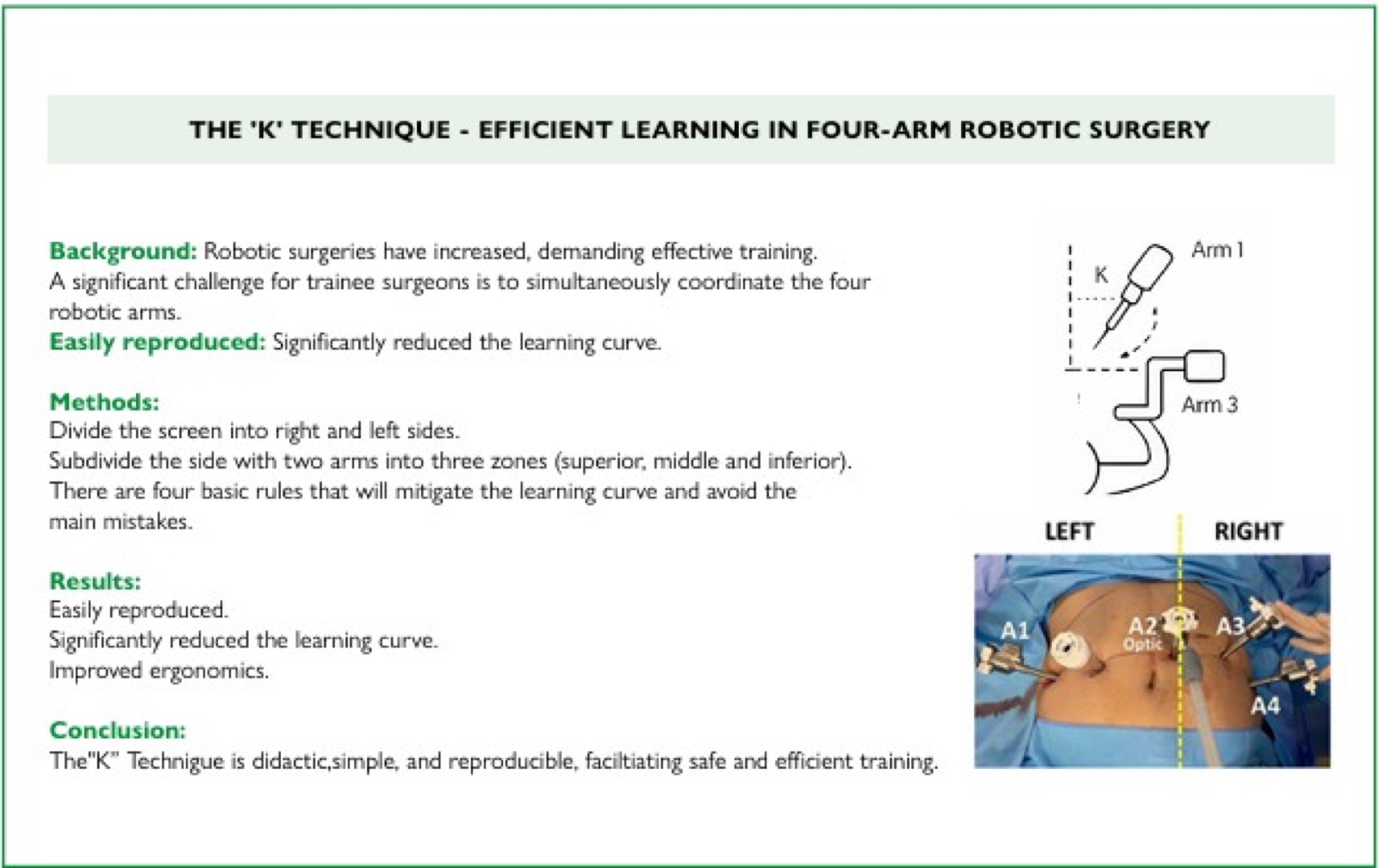
The number of robotic surgeries in the world grows every year. There is pressure to train surgeons, who face the challenge of transforming their surgical technique and adapting to new technology. However, there is a gap in training standardization that allows improvements to be assessed. One of the main technical challenges of the robotic platform with four working arms is their simultaneous cooperation through the movement itself. The technique presented in this article was developed based on the training of more than 400 robotic surgeons.
To describe the steps to be carried out when performing the training: activation of the arm during "swap" maneuvers (changing active instrument) during one surgical procedure, to understand the movement of the 4th robotic arm, using the letter "K" as a reference.
The screen will be divided into right and left and, then, the side of the screen that houses two working arms will be divided into three quadrants — top, bottom and middle. There are four basic rules that will mitigate the learning curve, avoiding the main mistakes that lead to considerations of instruments and difficulty in intracavitary mobility.
The K technique is a relevant resource in teaching robotic surgery, offering a simple and reproducible methodology for developing important skills to reduce the learning curve for new robotic surgeries.
It is unclear if there is a natural transition from laparoscopic to robotic surgery with transfer of abilities.
To measure the performance and learning of basic robotic tasks in a simulator of individuals with different surgical background.
Three groups were tested for robotic dexterity: a) experts in laparoscopic surgery (n=6); b) experts in open surgery (n=6); and c) non-medical subjects (n=4). All individuals were aged between 40-50 years. Five repetitions of four different simulated tasks were performed: spatial vision, bimanual coordination, hand-foot-eye coordination and motor skill.
Experts in laparoscopic surgery performed similar to non-medical individuals and better than experts in open surgery in three out of four tasks. All groups improved performance with repetition.
Experts in laparoscopic surgery performed better than other groups but almost equally to non-medical individuals. Experts in open surgery had worst results. All groups improved performance with repetition.




Developed by Surya MKT