

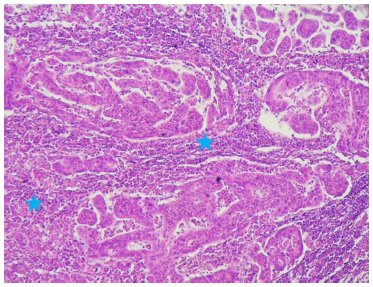
The prognostic value of tumor-infiltrating lymphocytes has been studied in several cancers, but in gastric cancer, their evaluation by standard hematoxylin-eosin staining remains controversial.
To analyze the prognostic value of tumor-infiltrating lymphocytes in gastric cancer and to investigate the association between tumor-infiltrating lymphocyte levels and a range of clinical and pathological factors in gastric cancer.
Forty-four patients were included with a mean age of 62 years, and 77% of the patients were classified as having pathological tumor stage 3 or pathological tumor stage 4. Lymph node metastases were noted in 66% of our patients. At diagnosis, 57% of patients were at an advanced stage (III). Patients with distant metastases were not included in this study. Evaluation of tumor-infiltrating lymphocytes in hematoxylin-eosin staining found that the mean tumor-infiltrating lymphocyte rate was 43 (extremes: 5-90%). 36% of patients had a tumor-infiltrating lymphocyte rate >50%. The overall survival of our patients was 40 months. Patients with tumor-infiltrating lymphocytes >50% had greater survival, without a significant correlation (p=0.275). A tumor-infiltrating lymphocyte rate =50% was correlated with age >50 years (p=0.030), presence of lymph node involvement (p=0.023), and advanced tumor stage (III+IV) (p=0.05). In a multivariate analysis, the presence of lymph node involvement (p=0.045) and advanced tumor stage (III+IV) (p=0.015) were identified as independent factors associated with a low tumor-infiltrating lymphocyte rate =50%.
Poor prognostic factors for gastric cancer (age >50 years, presence of lymph node involvement, and advanced tumor stage) were associated with a low tumor-infiltrating lymphocyte rate assessed by hematoxylin-eosin staining. However, standardization of tumor-infiltrating lymphocyte assessment is essential to allow comparability between studies and integrate this parameter into routine practice.
Early detection of changes in nutritional status is important for a better approach to the surgical patient. There are several nutritional measures in clinical practice, but there is not a complete method for determining the nutritional status, so, health professionals should only choose the best method to use.
To evaluate the total lymphocyte count and albumin as predictors of identification of nutritional risk in surgical patients.
Prospective longitudinal study was conducted with 69 patients undergoing surgery of the gastrointestinal tract. The assessment of nutritional status was evaluated by objective methods (anthropometry and biochemical tests) and subjective methods (subjective global assessment).
All parameters used in the nutritional assessment detected a high prevalence of malnutrition, with the exception of BMI which detected only 7.2% (n=5). The albumin (p=0.01), the total lymphocytes count (p=0.02), the percentage of adequacy of skinfolds (p<0.002) and the subjective global assessment (p<0.001) proved to be useful as predictors of risk of postoperative complications, since the smaller the values of albumin and lymphocyte count and higher the score the subjective global assessment were higher risks of surgical complications.
A high prevalence of malnutrition was found, except for BMI. The use of albumin and total lymphocyte count were good predictor for the risk of postoperative complications and when used with other methods of assessing the nutritional status, such as the subjective global assessment and the percentage of adequacy of skinfolds, can be useful for identification of nutritional risk and postoperative complications.




Developed by Surya MKT