

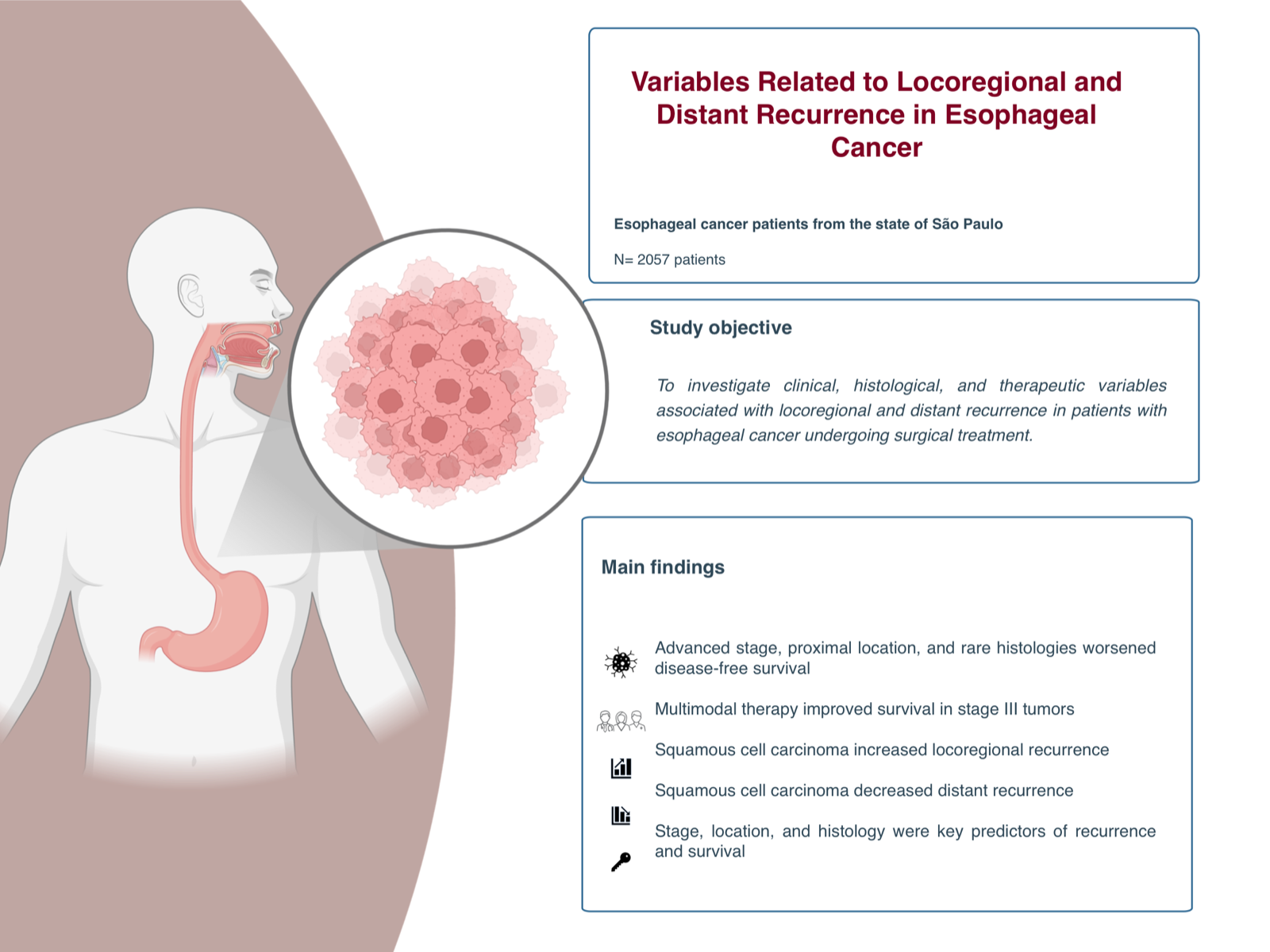
Esophageal cancer remains one of the most aggressive malignancies of the gastrointestinal tract, with high rates of recurrence and mortality despite curative-intent surgery and adjuvant therapies. Identifying factors associated with recurrence is crucial for improving outcomes and guiding personalized treatment.
The aim of this study was to evaluate pretreatment and treatment-related variables associated with recurrence in patients with esophageal cancer undergoing surgical resection.
This retrospective study analyzed data from patients with stage I–III esophageal carcinoma who underwent esophagectomy between 2000 and 2025, using the Fundação Oncocentro de São Paulo (FOSP) database. Clinical, histological, and treatment-related variables were evaluated. Disease-free survival and recurrence patterns were assessed using Cox proportional hazards models and Fine–Gray subdistribution hazard models.
A total of 2,057 patients were included, with a mean follow-up of 36.5 months (±44.8). In the multivariate analysis, advanced tumor stage (stage II: HR 1.68, 95%CI 1.21–2.33; stage III: HR 3.23, 95%CI 2.29–4.56; both p<0.01), location (middle esophagus: HR 1.31, 95%CI 1.11–1.54; p=0.001; upper esophagus: HR 1.54, 95%CI 1.21–1.96; p<0.001), and histological subtype (rare histologies: HR 2.17, 95%CI 1.35–3.49; p=0.001) were associated with worse disease-free survival. Multimodal therapy improved disease-free survival (HR 0.40, 95%CI 0.24–0.66) in stage III tumors. Squamous cell carcinoma was independently associated with locoregional recurrence (SHR 1.52, 95%CI 1.05–2.20; p=0.027). For distant recurrence, squamous cell carcinoma showed a protective effect (SHR 0.52, 95%CI 0.31–0.88; p=0.015), while high tumor grade (grade II: SHR 3.65, 95%CI 1.98–6.72; p<0.001) was associated with an increased risk. Multimodal treatments influenced recurrence patterns but did not independently predict outcomes after adjustment.
Tumor stage, location, and histology were strong predictors of disease-free survival after surgery for esophageal cancer. Histological subtypes significantly influenced recurrence patterns. Squamous cell carcinoma was associated with a higher risk of locoregional recurrence but a lower risk of distant metastasis compared to adenocarcinoma. Multimodal therapy demonstrated a protective effect in stage III disease.
Gastric cancer is the fifth most common and a leading cause of cancer death. Since 2005, perioperative chemotherapy (CT) has been the standard for non-metastatic gastric adenocarcinomas. Tumor response relies essentially on histological criteria.
The aim of the study was to evaluate tumor regression grade (TRG) after neoadjuvant CT and compare the Mandard and Becker scoring systems.
This 15-year retrospective study included patients with gastric adenocarcinoma treated with neoadjuvant CT and surgery. The TRG was assessed using Mandard and Becker scores, evaluated by area under the curve (AUC) for homogeneity, monotonicity, and discrimination. Tumors were staged by the American Joint Committee on Cancer and classified as the World Health Organization.
Forty patients (mean age 62 years; M:F ratio 2.6) were included. Tubular adenocarcinoma was the most common (48%), and 20% were stage IV. Mandard TRG1 and TRG5 each accounted for 15%, with median survivals of 48 and 30.5 months, respectively. For Becker TRG, they were 25.15 months (TRG 1), 24 months (TRG 2), and 54 months (TRG 3). The mean survival was 49.2 months for TRG1 and 39.2 months for TRG5 (Mandard), 50.3 months for TRG1 and 42.2 months for TRG3 (Becker). The positive predictive values for Mandard and Becker were 1.116 and 0.418 at 1 year and 5.719 and 1.820 at 5 years. The linearity values for Mandard and Becker were 0.6 and 0.3 at 1 year and 2.5 and 2.2 at 5 years. The AUC values at 1 year were 0.568 (Mandard), and 0.545 (Becker), and 0.606 for both at 5 years.
TRG is an independent survival predictor in gastric cancer, with similar performance between Mandard and Becker scores. Combined with ypTNM staging, it may enhance prognostic accuracy.
Esophagectomy is a major, invasive, and long-lasting surgery performed in patients with comorbidities and compromised nutritional conditions. The historical challenges of surgical treatment of esophageal cancer are to overcome mortality, improve survival, and decrease morbidity.
The aim of the study is to compare the intraoperative morbidity of two distinct surgical techniques of esophagectomy in esophageal cancer, transhiatal esophagectomy and video-assisted thoracoscopy in the prone position, analyzing intraoperative physiological parameters, scores on admission to the intensive care unit (ICU) (APACHE II, SOFA, and SAPS III), and postoperative evolution.
Retrospective, cross-sectional study evaluating patients admitted to the ICU in the immediate postoperative period of elective esophagectomy for esophageal neoplasia (squamous cell carcinoma and adenocarcinoma). Data were obtained from a computerized registry database of the ICU and from patient records.
Sixty-three patients over 18 years of age were evaluated and divided into two groups: 31 (49.21%) underwent transhiatal esophagectomy, and 32 (50.79%) underwent videoassisted thoracoscopic esophagectomy. No statistically significant difference was observed for length of ICU stay (p=0.5309), length of postoperative hospital stay (p=0.3066), or death in the perioperative period (30 days, p=0.6562). Regarding intraoperative parameters, no statistically significant difference was observed for patients who received blood transfusion (p=0.2097); amount in milliliters (p=0.2893); patients who used vasoactive drugs (VADs) (p=0.9243); time VAD use (p=0.9327); volume of fluids infused in milliliters (p=0.7825); or diuresis in milliliters (p=0.7286). A statistically significant difference was observed for surgical time (310 min in transhiatal esophagectomy vs. 373 min in video-assisted thoracoscopy, p=0.0012) and anesthetic time (385 minutes in transhiatal vs. 467 min in video-assisted thoracoscopy, p<0.0001). A statistically significant difference was observed in the number of patients extubated at the end of the procedure (48.38% in transhiatal vs. 9.37% in video-assisted thoracoscopy, p=0.0022). Regarding gasometric parameters at the end of the surgical procedure, only pO2 showed a statistically significant difference (p=0.0010). Regarding ICU admission scores, there were no differences regarding APACHE II (p=0.6542), SOFA (p=0.8949), and SAPS III (p=0.7656).
This study showed no differences between the transhiatal and thoracoscopic esophagectomy in the prone position, in prognostic score performance, studied operative parameters, ICU stay and hospital stay times, and perioperative mortality, in agreement with literature findings. The advent of minimally invasive techniques in video-assisted esophagectomies brought the same benefits as thoracotomy, offering greater safety in mediastinal dissection under direct vision, in addition to mitigating the physiological repercussions of thoracotomies.
Perioperative chemotherapy is the standard curative treatment for resectable gastric adenocarcinoma, significantly improving both overall and recurrence-free survival. The histological response to neoadjuvant therapy is a critical prognostic factor, commonly assessed through grading systems such as Mandard’s tumor regression grade (TRG).
The aim of the study was to identify predictive factors for histological response to neoadjuvant therapy in gastric adenocarcinoma.
A retrospective study was performed on patients with gastric adenocarcinoma who underwent surgery following neoadjuvant chemotherapy, from 2015 to 2020. The histological response was evaluated using Mandard TRG, which includes five grades (1–5), based on the proportion of residual viable tumor cells and fibrosis. Grades 1–3 were considered a response, and Grades 4 and 5 were considered no response. Students’ t-test, chi-squared test, and multivariate logistic regression were used, with significance set at p<0.05.
Forty patients were included (male-to-female ratio 2.64, mean age 63 years). Histological response (TRG 1–3) was observed in 48%, while 52% showed no response (TRG 4–5). Univariate analysis showed significant correlations between histological response and tumor size >38 mm (p=0.03), differentiation (p=0.02), parietal wall invasion, absence of nodal involvement (both p<0.001), pathological tumor, node, and metastasis stage (p<0.001), and absence of vascular and perineural invasion (both p=0.001). Multivariate analysis identified parietal wall invasion (odds ratio=2.351, p=0.022) and absence of lymph node metastases (odds ratio=1.491, p=0.01) as independent predictive factors.
Parietal wall invasion and absence of nodal metastases are predictive of histological response to neoadjuvant therapy in gastric adenocarcinoma.
The analysis of tumor budding (TB) and its prognostic value in gastric adenocarcinoma (GA) has been the focus of several studies, with inconsistent results. This parameter is not included in gastric prognostic classifications or standardized pathological reports.
To evaluate TB in GA and its prognostic significance through survival analysis, in addition to investigating the association between TB and clinicopathological markers that are considered prognostic factors for this type of cancer.
This retrospective study covers a period of ten years, from January 2008 to December 2017. It included patients who underwent surgery for GA. TB evaluation followed the 2016 consensus guidelines for colorectal cancer, with three grades: Bd1 (0–4 buds), Bd2 (5–9 buds), and Bd3 (10 or more buds). Additionally, a two-grade classification system was employed, distinguishing between low-grade budding (fewer than 10 buds) and high-grade budding (10 or more buds).
TB was classified as low-grade in 69% of the cases and high-grade in 31%. High-grade TB was significantly correlated with perineural invasion (HR [hazard ratio]: 2.98, 95%CI [95% confidence interval] 1.04–8.53, p=0.004), stages III and IV (HR 4.04, 95%CI 1.27–12.83, p=0.01), and mortality (HR 3.65, 95%CI 1.24–10.74, p=0.02). It was an independent prognostic factor for recurrence-free survival (RFS) (p=0.005, p<0.05).
We have demonstrated that TB prognostic and predictive value in GA is significant, particularly regarding patient survival.
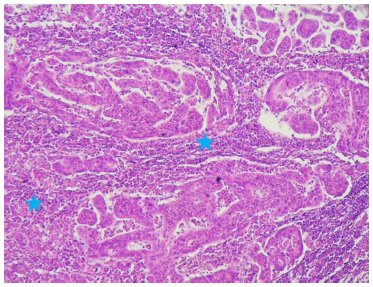
The prognostic value of tumor-infiltrating lymphocytes has been studied in several cancers, but in gastric cancer, their evaluation by standard hematoxylin-eosin staining remains controversial.
To analyze the prognostic value of tumor-infiltrating lymphocytes in gastric cancer and to investigate the association between tumor-infiltrating lymphocyte levels and a range of clinical and pathological factors in gastric cancer.
Forty-four patients were included with a mean age of 62 years, and 77% of the patients were classified as having pathological tumor stage 3 or pathological tumor stage 4. Lymph node metastases were noted in 66% of our patients. At diagnosis, 57% of patients were at an advanced stage (III). Patients with distant metastases were not included in this study. Evaluation of tumor-infiltrating lymphocytes in hematoxylin-eosin staining found that the mean tumor-infiltrating lymphocyte rate was 43 (extremes: 5-90%). 36% of patients had a tumor-infiltrating lymphocyte rate >50%. The overall survival of our patients was 40 months. Patients with tumor-infiltrating lymphocytes >50% had greater survival, without a significant correlation (p=0.275). A tumor-infiltrating lymphocyte rate =50% was correlated with age >50 years (p=0.030), presence of lymph node involvement (p=0.023), and advanced tumor stage (III+IV) (p=0.05). In a multivariate analysis, the presence of lymph node involvement (p=0.045) and advanced tumor stage (III+IV) (p=0.015) were identified as independent factors associated with a low tumor-infiltrating lymphocyte rate =50%.
Poor prognostic factors for gastric cancer (age >50 years, presence of lymph node involvement, and advanced tumor stage) were associated with a low tumor-infiltrating lymphocyte rate assessed by hematoxylin-eosin staining. However, standardization of tumor-infiltrating lymphocyte assessment is essential to allow comparability between studies and integrate this parameter into routine practice.
Microscopic analysis of tumor budding (TB) may be an essential predictive tool for regional lymph node metastases in colorectal cancer, especially among patients in intermediate stages, who exhibit considerable prognostic variability.
The aim of this study was to assess the predictive power of BT regarding the presence of lymph node metastases and its association with other characteristics related to colorectal carcinoma progression.
This is a cross-sectional, retrospective study with a quantitative approach, focusing on the review of medical records and histopathological reports of patients who underwent oncologic surgery for colorectal cancer.
A total of 153 patient records were examined, with a predominance of the 61-70 age group and a male majority (50.98%). Adenocarcinoma not otherwise specified was the most common histological type (60.78%), with the majority exhibiting moderate differentiation (87.58%). From the total sample, 97 cases (63.39%) exhibited TB, with 51.55% classified as a high budding score. Invasion of adipose tissue/subserosa was the most prevalent, occurring in 46.41% of cases. Regional lymph node metastases and angiolymphatic invasion were observed in 66 and 101 patients, respectively. Cross-tabulation analysis showed a statistically significant association between TB and lymph node metastasis (p<0.05).
The relationship between TB and lymph node metastasis highlights the significance of this histological factor in the risk stratification and prognosis of patients with colorectal cancer, complementing TNM staging. Therefore, the assessment of tumor budding is crucial in histopathological reports, potentially influencing additional therapeutic decisions.
Cholangiocarcinoma (CCA) is a rare neoplasm, with high mortality, originating in the bile ducts. Its incidence is higher in Eastern countries due to the endemic prevalence of liver parasites. Factors such as metabolic syndrome, smoking, and pro-inflammatory conditions are also linked to the disease. Clinical features include asthenia, abdominal pain, cholestasis, and increased serum levels of CEA and CA19-9.
The aim of this study was to evaluate CCA prevalence, survival, and potential prognostic and therapeutic implications in a patient cohort and assess correlations with clinical laboratory data and possible associated risk factors.
This is a retrospective study of the clinical and histological data of patients diagnosed with CCA at Santa Casa de Misericórdia in Porto Alegre, Brazil, between 2016 and 2021.
There was a 56% prevalence of CCA in women, with intrahepatic localization in 55.4% of cases and unifocality in 85.6% of patients. The mean age of the patients was 63 years (26–89 years), with a mean tumor size of 5.5 cm. The median survival time was 7 months (0 to >50). CA19-9 was altered in 81% of patients, whereas GOT/GPT was altered in 62.5% and gamma-glutamyl transferase/alkaline phosphatase/bilirubin in 69.1% of patients. Mortality was higher among patients with extrahepatic CCA.
Risk factors such as smoking, cholecystectomy, cirrhosis, intrahepatic lithiasis, and transplantation should be considered individually by the attending physician for radiological monitoring and incidental discovery of the neoplasm. Lack of timely identification by the attending physician can delay diagnosis, increasing mortality.
Anal cancer is a relatively rare disease, and there is a lack of survival data from low- and middle-income countries.
The aim of this study was to investigate the survival rates and prognostic factors of anal cancer cases treated at a High-Complexity Oncology Care Center in Rio de Janeiro, Brazil.
A retrospective cohort study was conducted involving 665 cases of squamous cell carcinoma of the anus/anal canal treated from 2000 to 2016. To estimate the 5-year overall survival probability and survival according to selected variables, the Kaplan-Meier method and the log-rank test were applied. To identify factors associated with survival, the Cox proportional hazards model, stratified by staging, was used to estimate hazard ratios (HR). Ninety-five percent confidence intervals (95%CI) were also calculated.
The overall survival probability was 62.20% (95%CI 57.90–66.20). Higher survival rates were observed in female cases, those with non-advanced staging, and those treated with chemoradiotherapy (p<0.001). Among cases with advanced staging, being female was a protective factor against death (HR=0.52; 95%CI 0.28–0.93). Compared to chemoradiotherapy, at least one type of treatment was identified as a risk factor: chemoradiotherapy + surgery among cases with non-advanced staging (HR=22.65; 95%CI 5.65–90.81), radiotherapy among cases with advanced staging (HR=2.71; 95%CI 1.39–5.30), and among cases with unknown staging, no treatment (HR=3.36; 95%CI 1.73–6.50), radiotherapy (HR=2.38; 95%CI 1.46–3.88), and radiotherapy + surgery (HR=3.99; 95%CI 1.20–13.27).
The findings support the superiority of chemoradiotherapy over other therapeutic modalities for anal cancer, resulting in increased survival and a better prognosis.
Surgery after neoadjuvant chemotherapy (CT) improves the prognosis of colorectal liver metastases (CRLM).
The aim of this study was to evaluate the predictive factors of the histological response of CRLM after neoadjuvant treatment.
A retrospective monocentric study including patients with CRLM operated after neoadjuvant treatment. Assessment of histological response was based on the Rubbia-Brandt tumor regression grading score. The scores were grouped into two types of response: Response Group (R) and No Response Group (NR).
The study included 77 patients (mean age=56 years, sex ratio=1.57). Node metastases were noticed in 62% of cases. Synchronous liver metastasis was present in 42 cases (55%) and metachronous liver metastasis in 45%. Neoadjuvant treatment consisted of CT only in 52 patients (68%) and CT with targeted therapy in 25 patients (32%). Chemo-induced lesions were present in 44 patients (57%). Histological response was presented (Group R) in 36 cases (47%) and absent (Group NR) in 41 cases (53%). The overall survival of our patients was 32 months. For Group R, survival was significantly greater (p=0.001). The predictive factors of histological response identified were delay in the onset of liver metastasis greater than 14 months (p=0.027) and neoadjuvant treatment combining CT and targeted therapy (p=0.031). In multivariate analysis, the type of neoadjuvant treatment (p=0.035) was an independent predictive factor of histological response.
Predictive factors of histological response would allow us to identify patients who would benefit most from neoadjuvant treatment. These patients with CRLM onset of more than 14 months and treated with CT combined with targeted therapy would be the best candidates for a neoadjuvant CT strategy followed by surgical resection.




Developed by Surya MKT