

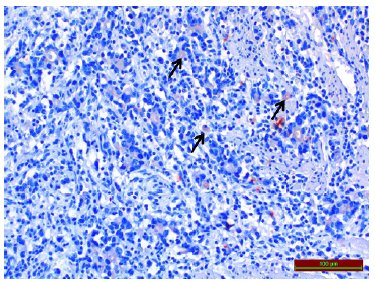
Isthmin-1, a recently discovered adipokine, was first characterized for its role in early brain development. Subsequent studies have demonstrated that isthmin-1 is involved in a broad range of biological processes, including metabolism, immunity, tumorigenesis, cellular proliferation, endothelial permeability, and organ development.
This study aimed to evaluate isthmin-1 immunoreactivity in tumor tissues obtained from gastric cancer patients using immunohistochemistry and to assess its usefulness in the diagnosis and histological evaluation of gastric cancer.
The patients were divided into three groups: adenocarcinoma, intestinal metaplasia, and healthy controls. Endoscopic biopsies, obtained according to the Sydney protocol, were examined for the control group and patients diagnosed with intestinal metaplasia. In contrast, surgical resection tissues were used for patients diagnosed with gastric adenocarcinoma.
All materials were examined histopathologically. No significant difference in isthmin-1 levels was detected between the control and intestinal metaplasia groups, based on immunohistochemical staining. However, when gastric adenocarcinoma cases were compared with the control and intestinal metaplasia groups, a significant decrease in isthmin-1 immunoreactivity was observed in adenocarcinoma cases. Patients with adenocarcinoma were grouped as well-differentiated, moderately differentiated, and poorly differentiated, and then staged according to the TNM staging system. Histopathological examination revealed no significant differences in the degree of differentiation or TNM stage.
We believe that isthmin-1 can be used as a biomarker in the diagnosis of malignant gastric diseases in the future. However, more comprehensive and extensive scientific studies are needed to determine its usefulness in tumor staging or prognosis monitoring.
Gastric adenocarcinoma is more often found in men over 50 years in the form of an antral lesion. The tumor has heterogeneous histopathologic features and a poor prognosis (median survival of 15% in five years).
To estimate the relationship between the presence of nodal metastasis and other prognostic factors in sporadic gastric adenocarcinoma.
Were evaluated 164 consecutive cases of gastric adenocarcinoma previously undergone gastrectomy (partial or total), without clinical evidence of distant metastasis, and determined the following variables: topography of the lesion, tumor size, Borrmann macroscopic configuration, histological grade, early or advanced lesions, Lauren histological subtype, presence of signet ring cell, degree of invasion, perigastric lymph node status, angiolymphatic/perineural invasion, and staging.
Were found 21 early lesions (12.8%) and 143 advanced lesions (87.2%), with a predominance of lesions classified as T3 (n=99/60, 4%) and N1 (n=62/37, 8%). The nodal status was associated with depth of invasion (p<0.001) and tumor size (p<0.001). The staging was related to age (p=0.048), histological grade (p=0.003), and presence of signet ring cells (p = 0.007), angiolymphatic invasion (p = 0.001), and perineural invasion (p=0.003).
In gastric cancer, lymph node involvement, tumor size and depth of invasion are histopathological data associated with the pattern of growth/tumor spread, suggesting that a wide dissection of perigastric lymph nodes is a fundamental step in the surgical treatment of these patients.




Developed by Surya MKT