

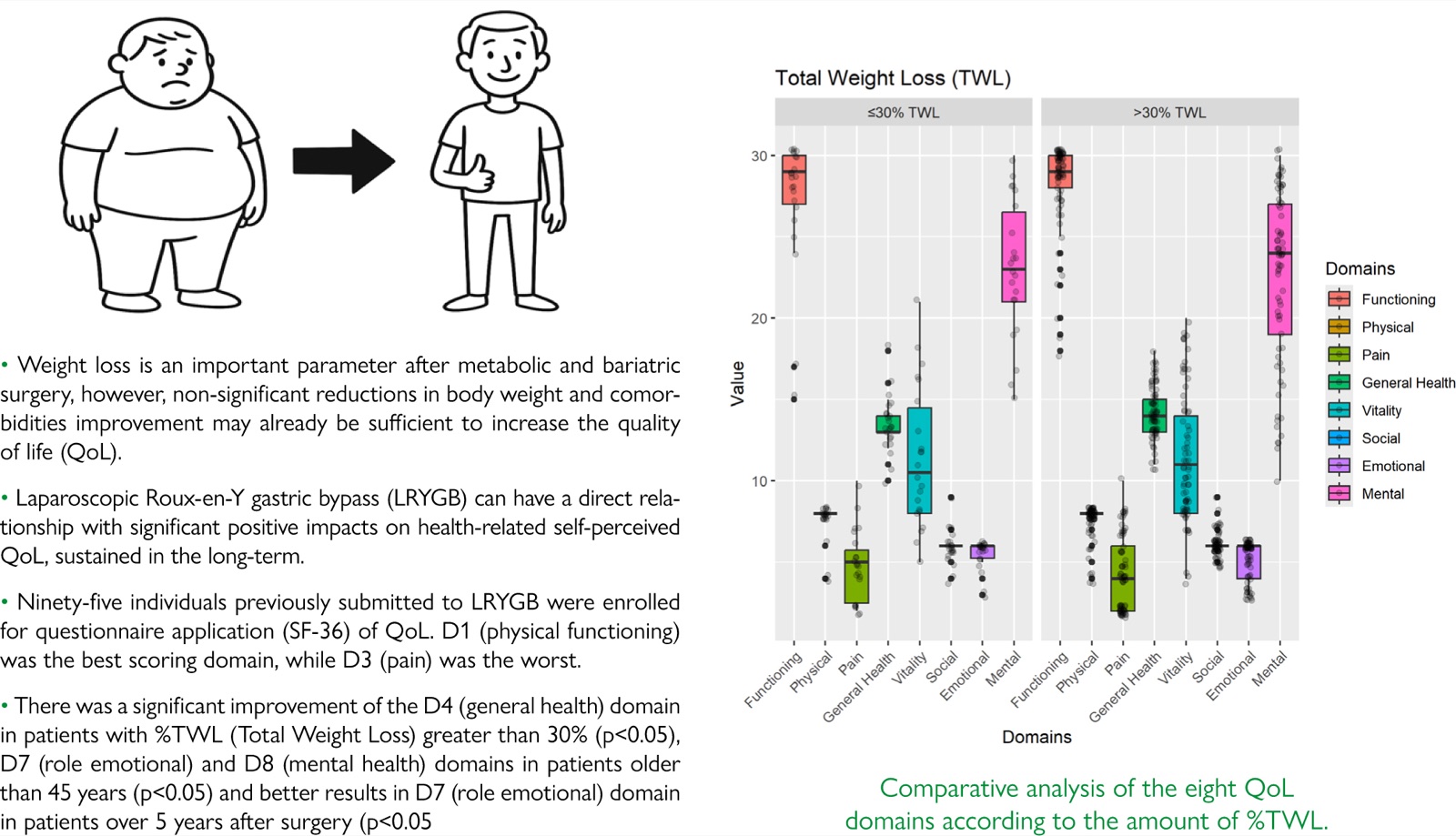
Weight loss (WL) is the most commonly used datum to measure the results of metabolic and bariatric surgery. The amount of WL is generally directly and proportionally associated with the improvement in quality of life (QoL), as the greater the former, the greater the perception of well-being.
To assess the relationship between the amount of weight lost after laparoscopic Roux-en-Y gastric bypass (LRYGB) and self-perceived improvement in quality of life (QoL).
The medical records of patients who underwent LRYGB between January 2017 and December 2019 with a minimum follow-up of 3 years were analyzed. The data obtained in the subgroups made up according to percentage of total weight loss (%TWL), age, and time elapsed since surgery were compared with the self-perceived QoL by the Short Form Survey 36 (SF-36) questionnaire.
A total of 95 individuals (71.6% women) with an average age of 45 years and an average postoperative (PO) follow-up of 61.1 months were enrolled. The mean pre- and postoperative weight was 114 kg and 73.4 kg, respectively, and the mean %TWL was 35.6%. According to the comparison between the data from the medical records and the self-perceived QoL assessment, D1 (physical functioning) was the best scoring domain, while D3 (pain) was the worst. There was a significant improvement of the D4 (general health) domain in patients with %TWL greater than 30% (p<0.05), D7 (role emotional), and D8 (mental health) domains in patients older than 45 years (p<0.05) and better results in D7 (role emotional) domain in patients over 5 years after surgery (p<0.05).
Greater weight loss and age and longer time after surgery showed important self-perceived improvement in QoL after LRYGB in some assessment domains, both physical and emotional.
Bariatric surgery is currently the gold standard for the treatment of obesity. However, weight recurrence varies among the different surgical methods.
To compare changes in weight one and two years after bariatric surgery considering the gastric bypass and gastric sleeve methods.
A cross-sectional study was conducted at a hospital with adults of both sexes followed up for two years after surgery. Anthropometric, sociodemographic, clinical, and lifestyle characteristics were analyzed.
A total of 184 patients, predominantly women (82.1%), were assessed (136 submitted to gastric sleeve and 48 to gastric bypass). Good adherence to the multivitamin, but not to diet or physical activity, was verified in both groups. The percentages of weight loss and excess weight loss were higher in the gastric bypass group (one year after surgery: p<0.001 and p=0.010, respectively; two years after surgery: p<0.001 and p<0.001, respectively). Average weight gain was 2.37 kg and higher after gastric sleeve (p=0.042), whereas no difference between methods was found for the percentage of weight recurrence. Weight loss and recurrence at the two-year follow-up were influenced by diet in both groups. The percentage of weight loss was higher after gastric bypass one and two years after surgery. Weight recurrence was higher after the gastric sleeve method, without interfering with the surgical success of the technique.
We verified greater efficacy in the gastric bypass technique in terms of weight loss at 12 and 24 months postoperatively. Weight recurrence was found 24 months after both methods, especially in the gastric sleeve group, without constituting surgical failure.
Bariatric surgery is the most effective treatment for weight loss and also promotes remission of preoperative metabolic comorbidities.
The aim of this study was to analyze preoperative comorbidities, evaluate postoperative outcomes, and assess complications 6 months after bariatric surgery in a hospital in the state of Santa Catarina, Brazil.
A retrospective cohort study was conducted with patients who underwent bariatric surgery between 2021 and 2022 and were followed up for a period of 6 months after the procedure.
There was a predominance of female patients (81.6%), with a mean age of 38.7 years. The preoperative prevalence of hypertension, Type 2 diabetes, dyslipidemia, and hepatic steatosis was 36.7, 22.4, 22.4, and 32.7%, respectively. The postoperative remission rates for these conditions were 55, 64, 70, and 69%, respectively. Except for diabetes, no significant differences were found between the Roux-en-Y gastric bypass (RYGB) and sleeve gastrectomy (SG) groups. There was a significant reduction in weight (p<0.01) and body mass index (BMI) (p<0.01), with no statistical differences between the RYGB and SG groups. Postoperative complications occurred in 73.5% of patients, including anemia, vitamin deficiencies, cholelithiasis, dumping syndrome, anastomotic ulcer, chronic diarrhea, and anastomotic stricture.
The study described the preoperative comorbidity profile, postoperative outcomes, and complications with findings consistent with existing literature, except for underreporting dyslipidemia and hepatic steatosis. No statistical difference was observed between the surgical techniques performed.
Preoperative hospitalization with the purpose to obtain more effective weight loss provides intensive care for patients who have a higher body mass index (BMI) and associated diseases that involve a greater risk of peri- and postoperative complications. It is a therapeutic strategy that can make it possible to overcome obstacles related to the difficulty of adhering to obesity treatment.
To analyze the implementation of a preoperative hospitalization strategy for weight loss in patients eligible for bariatric surgery.
Retrospective study that included 194 patients with a BMI=50 kg/m2. They were grouped according to preoperative preparation strategies: inpatient (n=32) and outpatient (n=162), who underwent Roux-en-Y gastric bypass (RYGB) or sleeve gastrectomy (SG) between 2010 and 2020. The groups were compared regarding preoperative weight loss before and after the strategies and postoperative up to two years after surgery.
Most patients were female and there were significant differences in age group (an average of 42.94 years in the preoperative hospitalization strategy group and 37.73 in the outpatient strategy group). The mean BMI in the hospitalized group was 63.01±8.72 kg/m2, and in the outpatient group it was 54.95±4.31 kg/m2. There was a significant difference only between initial and preoperative weight in the hospitalized group. Furthermore, the difference between initial weight and last recorded weight up to two years after surgery was significant in each group. The occurrence of associated diseases was higher in the outpatient group.
Patients following the preoperative hospitalization strategy experienced significant weight loss before surgery.
The association of gastric plication with fundoplication is a reliable option for the treatment of individuals with obesity associated with gastroesophageal reflux disease.
To describe weight loss, endoscopic, and gastroesophageal reflux disease-related outcomes of gastric plication with fundoplication in individuals with mild obesity.
A retrospective cohort study was carried out, enrolling individuals who underwent gastric plication with fundoplication at a tertiary private hospital from 2015–2019. Data regarding perioperative and weight loss outcomes, endoscopic and 24-hour pH monitoring findings, and gastroesophageal reflux disease-related symptoms were analyzed.
Of 98 individuals, 90.2% were female. The median age was 40.4 years (IQR 32.1–47.8). The median body mass index decreased from 32 kg/m2 (IQR 30,5–34) to 29.5 kg/m2 (IQR 26.7–33.9) at 1–2 years (p<0.05); and to 27.4 kg/m2 (IQR 24.1–30.6) at 2–4 years (p=0.059). The median percentage of total weight loss at 1–2 years was 7.8% (IQR −4.1–14.7) and at 2–4 years, it was 16.4% (IQR 4.3–24.1). Both esophageal and extra-esophageal symptoms showed a significant reduction (p<0.05). A significant decrease in the occurrence of esophagitis was observed (p<0.01). The median DeMeester score decreased from 30 (IQR 15.1–48.4) to 1.9 (IQR 0.93–5.4) (p<0.0001).
The gastric plication with fundoplication proved to be an effective and safe technique, leading to a significant and sustained weight loss in addition to endoscopic and clinical improvement of gastroesophageal reflux disease.
Although bariatric surgery is highly effective for the treatment of obesity and its comorbidities, preoperative weight loss has an impact on its results.
Although bariatric surgery is highly effective for the treatment of obesity and its comorbidities, preoperative weight loss has an impact on its results.
The aim of this study was to correlate preoperative weight loss with the outcome of bariatric surgery using the Bariatric Analysis and Reporting Outcome System scores.
This is a cross-sectional, observational study with 43 patients undergoing bariatric surgery that compared a group of 25 patients with a percentage of preoperative excess weight loss ³8% with a group of 18 patients with a percentage of preoperative excess weight loss <8% or with weight gain. The research took place at the bariatric surgery outpatient clinic of the Oswaldo Cruz University Hospital with patients 1 year after the surgery.
Patients had a mean age of 40.8 years (42.7 percentage of preoperative excess weight loss ≥8% vs. 38.2 percentage of preoperative excess weight loss <8%, p=0.095). No significant difference was found between the two groups regarding preoperative comorbidities and body mass index at entry into the program. Higher preoperative body mass index (48.69 vs. 44.0; p=0.029) was observed in the group with percentage of preoperative excess weight loss <8%. No significant difference was found regarding the percentage of excess weight loss (71.4±15.4%; percentage of preoperative excess weight loss ≥8% vs. 69.47%±14.5 percentage of preoperative excess weight loss <8%; p=0.671), the result of the surgery according to the Bariatric Analysis and Reporting Outcome System scores protocol, the resolution of comorbidities, the quality of life, and the surgical complications between the two groups.
Based on the available data, it is reasonable that bariatric surgery should not be denied to people who have not achieved pre-established weight loss before surgery.
Obesity is a chronic disease with high growth in population and bariatric surgery is currently considered the most effective treatment for weight reduction; on the other hand, nutritional deficiencies are observed after this procedure.
To analyze weight loss progression and nutritional anemia in patients submitted to Roux-en-Y gastric bypass on use of vitamin and mineral supplementation.
Retrospective analysis of 137 patients of both sexes, aged between 18-60 years, using supplemental multivitamins and minerals, were included; personal information, anthropometric and laboratory data in the preoperative, 12, 24, 36 and 48 months postoperatively were collected.
Postoperatively, in both sexes, occurred weight loss compared to the pre-operative weight gain at 48 months and maintenance of body mass index. There was a decrease in the percentage of excess weight loss at 48 months postoperatively compared to the time of 12, 24 and 36 months in men and decreased at 48 postoperative months compared to the time of 24 months in females. There was a decreased in serum ferritin in both sexes and increased serum iron at 48 months postoperatively in males. There was a decreased in vitamin B12 and folic acid increased serum at 48 postoperative months in females.
Surgical treatment was effective for reducing weight, body mass index reduction and achievement of success in the late postoperative period along with multivitamin and mineral supplementation on prevention of serious nutritional deficiencies and anemia.
Weight loss and malnutrition may be caused by many factors, including type of disease and treatment.
The present study investigated the occurrence of in-hospital weight loss and related factors.
This cross-sectional study investigated the following variables of 456 hospitalized patients: gender, age, disease, weight variation during hospital stay, and type and acceptance of the prescribed diet. Repeated measures analysis of variance (ANOVA) was used for comparing patients' weight in the first three days in hospital stay and determining which factors affect weight. The generalized estimating equation was used for comparing the food acceptance rates. The significance level was set at 5%.
The most prescribed diet was the regular (28.8%) and 45.5% of the patients lost weight during their stay. Acceptance of hospital food increased from the first to the third days of stay (p=0.0022) but weight loss was still significant (p<0.0001). Age and type of prescribed diet did not affect weight loss during the study period but type of disease and gender did. Patients with neoplasms (p=0.0052) and males (p=0.0002) lost more weight.
Weight loss during hospital stay was associated only with gender and type of disease.
Bariatric surgery is currently the gold standard treatment for obesity. The two most accomplished surgeries are the Roux-en-Y gastric bypass and the sleeve gastrectomy, and controversies exist in which is better.
To compare the two techniques in relation to weight loss with at least five years of follow-up.
Search in Medline, PubMed, Embase, SciElo, Lilacs, Cochrane databases from 2001 (beginning of vertical gastrectomy) until 2018, using the following headings: “sleeve” or “sleeve gastrectomy” combined with “gastric bypass” or “Roux-en-Y gastric bypass”, “weight loss” and “clinical trial”. Criteria for inclusion of articles were patients aged between 18 and 65 years; clinical trial; comparison between the two techniques; minimum five-year follow-up; outcome with weight loss assessment.
The initial search identified 1940 articles, of which 185 publications were identified as clinical trials. One hundred and forty-one were excluded, 67 because they did not compare the two techniques, 57 not addressed weight loss and 17 were repeated articles. Thirty-four studies were retrieved for a more detailed analysis; 36 studies were excluded due to a follow-up of less than five years, and another compared the mini-gastric bypass. In total, seven studies were included in the systematic review, but there was no significant difference in three of them.
The gastric bypass had a greater weight loss than the vertical gastrectomy in all the evaluated studies.
Factors related to weight loss in obese patients undergoing bariatric surgery have always been exhaustively studied in an attempt to propose the best surgical technique with greater weight loss and long-term resolution of comorbidities. Patients present anatomical variations regarding the length of the small intestine. Some studies demonstrate weight changes in patients with different lengths of the intestinal loops in the Roux-en-Y bypass technique. The present work carried out a study on the influence of body mass index, weight loss, and common loop length on long-term surgical outcomes.
This is a descriptive cross-sectional study by retrospective analysis of 112 medical records of patients undergoing open bariatric surgery using the gastric bypass technique at University Hospital - UFPR. The data were correlated in statistical programs for this purpose.
Out of 112 patients, 83.03% were women, with mean age of 41.52 years. The mean length of the total small bowel of the patients was 5.02 m. There was a directly proportional relationship between the length of the small intestine and weight loss (p=0.0428).
There is a wide range of variables related to weight loss in patients undergoing bariatric surgery, such as the technique used, the length of the loops in the Roux-en-Y gastric bypass, and the routine of nutritional and physical monitoring of the patient. It is important to assess the technical details of the surgical procedure and to verify the weight loss by evaluating integrally the patient and other variables.




Developed by Surya MKT