


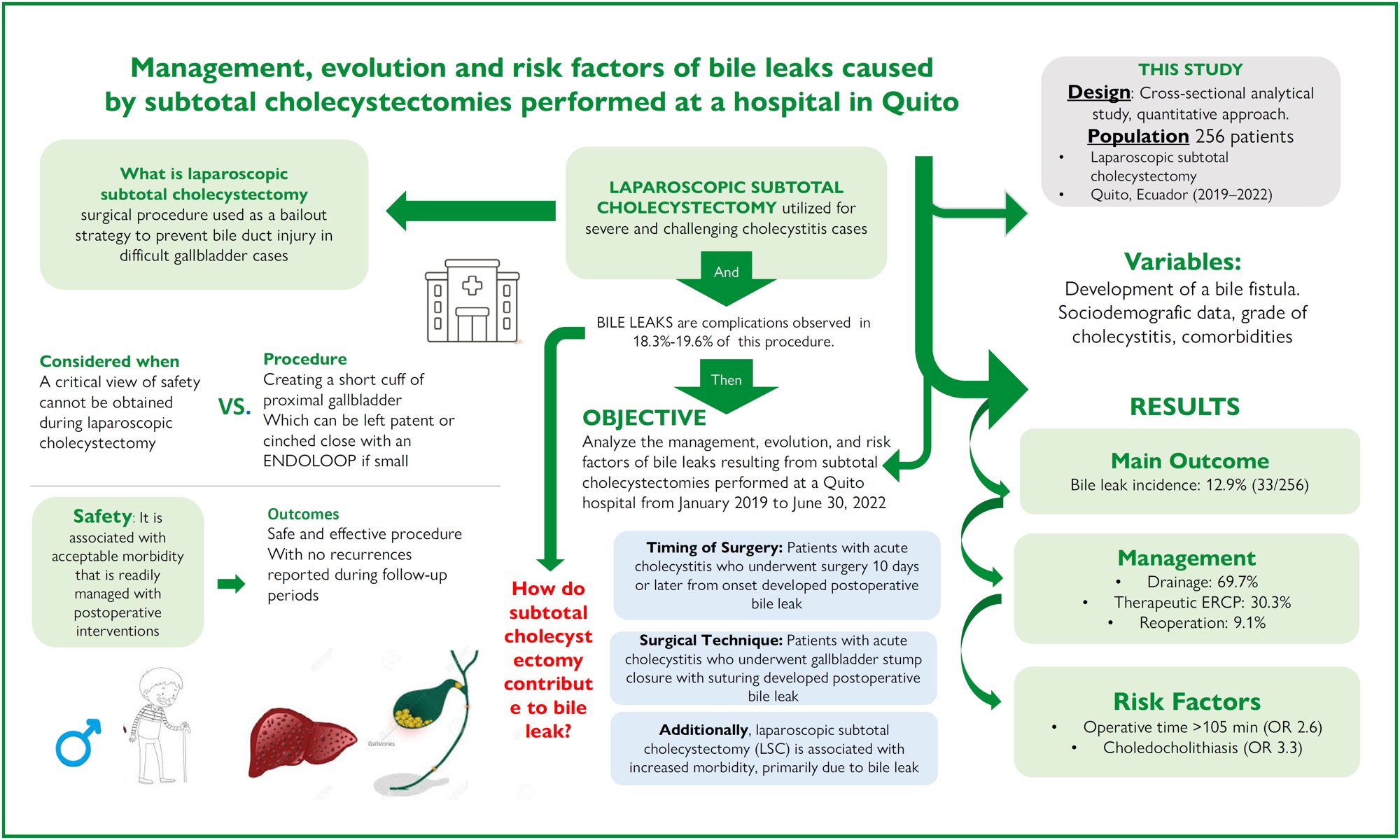
Laparoscopic subtotal cholecystectomy is indicated for severe cholecystitis; however, it may lead to complications, including postoperative bile fistulas.
To evaluate the management, evolution, and risk factors associated with bile fistulas after laparoscopic subtotal cholecystectomy in a hospital in Quito from January 2019 to June 2022.
A cross-sectional analytical study with a quantitative approach was conducted. A retrospective review of medical records of patients who underwent laparoscopic subtotal cholecystectomy (n=256) was performed. The dependent variable was the occurrence of bile fistulas, while independent variables included sociodemographic data (age, sex) and clinical factors such as comorbidities, nutritional status, cholecystitis severity (Parkland classification), surgical planning, type of cholecystectomy, anesthetic risk (American Society of Anesthesiologists; ASA I–IV), surgical time, intraoperative complications, time of fistula onset, evolution, and postoperative complications.
The incidence of postoperative fistulas was 12.9% (n=33). Management strategies included drainage (69.7%) and endoscopic retrograde cholangiopancreatography (ERCP) (30.3%). Spontaneous closure occurred in 60.6%, while 30.3% required therapeutic ERCP and 9.1% needed reoperation. Significant risk factors included surgical time >105 minutes (relative risk [RR]: 2.06; 95% confidence interval [CI] 1.04–4.08), type A cholecystectomy (RR 2.19; 95%CI 1.05–4.57), and choledocholithiasis (RR 2.5; 95%CI 1.34–4.67). Logistic regression confirmed surgical time (odds ratio [OR]: 2.6; 95%CI 1.2–5.8) and choledocholithiasis (OR 3.3; 95%CI 1.4–3.9) as significant predictors (p<0.05).
The incidence of postoperative fistulas observed was comparable to previous reports in the literature, highlighting the importance of early identification and appropriate management.




Developed by Surya MKT