


Roux-en-Y gastric bypass promotes weight loss in patients with severe obesity and improves type 2 diabetes mellitus, which, in some cases, can lead to remission. The action of enteric hormones is relevant for the initial outcomes and late disease evolution.
To evaluate the influence of enteric hormone secretion on the evolution of type 2 diabetes mellitus three years after Roux-en-Y gastric bypass.
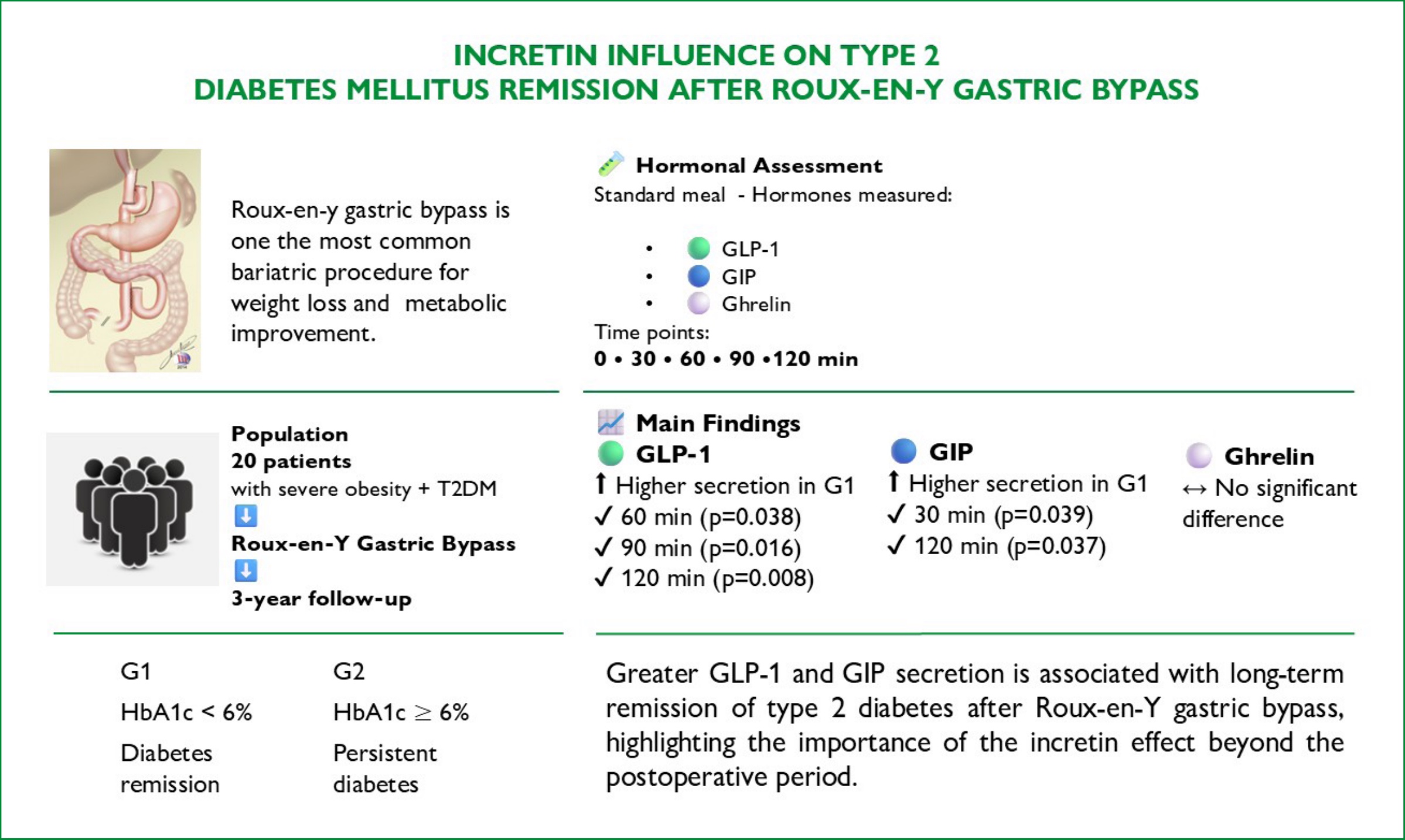
A total of 20 patients were evaluated, divided into 2 groups: group 1, glycated hemoglobin<6%, and group 2, glycated hemoglobin≥6%. Hormone secretion (ghrelin, GLP-1, and GIP) was analyzed at pre-specified time points following a standard meal.
Group 1 had higher mean secretion at 30 and 120 minutes ([992.60±806.78 vs. 407.97±186.80, p=0.039, p<0.05] and [418.72±219.11 vs. 240.14±121.11, p=0.037, p<0.05], respectively) than group 2. Group 1 presented higher GLP values at 60 [724 (195–1,483) vs. 214 (67–424), p=0.038, p<0.05], 90 [473 (200–943) vs. 180 (120–318), p=0.016, p<0.05] and 120 minutes [565 (278–770) vs. 163 (81–339), p=0.008, p<0.05] compared to group 2. There was no difference between the groups regarding ghrelin.
Higher secretion of GIP and GLP-1 was observed in patients with type 2 diabetes mellitus remission. The incretin factor is important in late disease evolution even in a group of patients with severe diabetes.




Developed by Surya MKT