


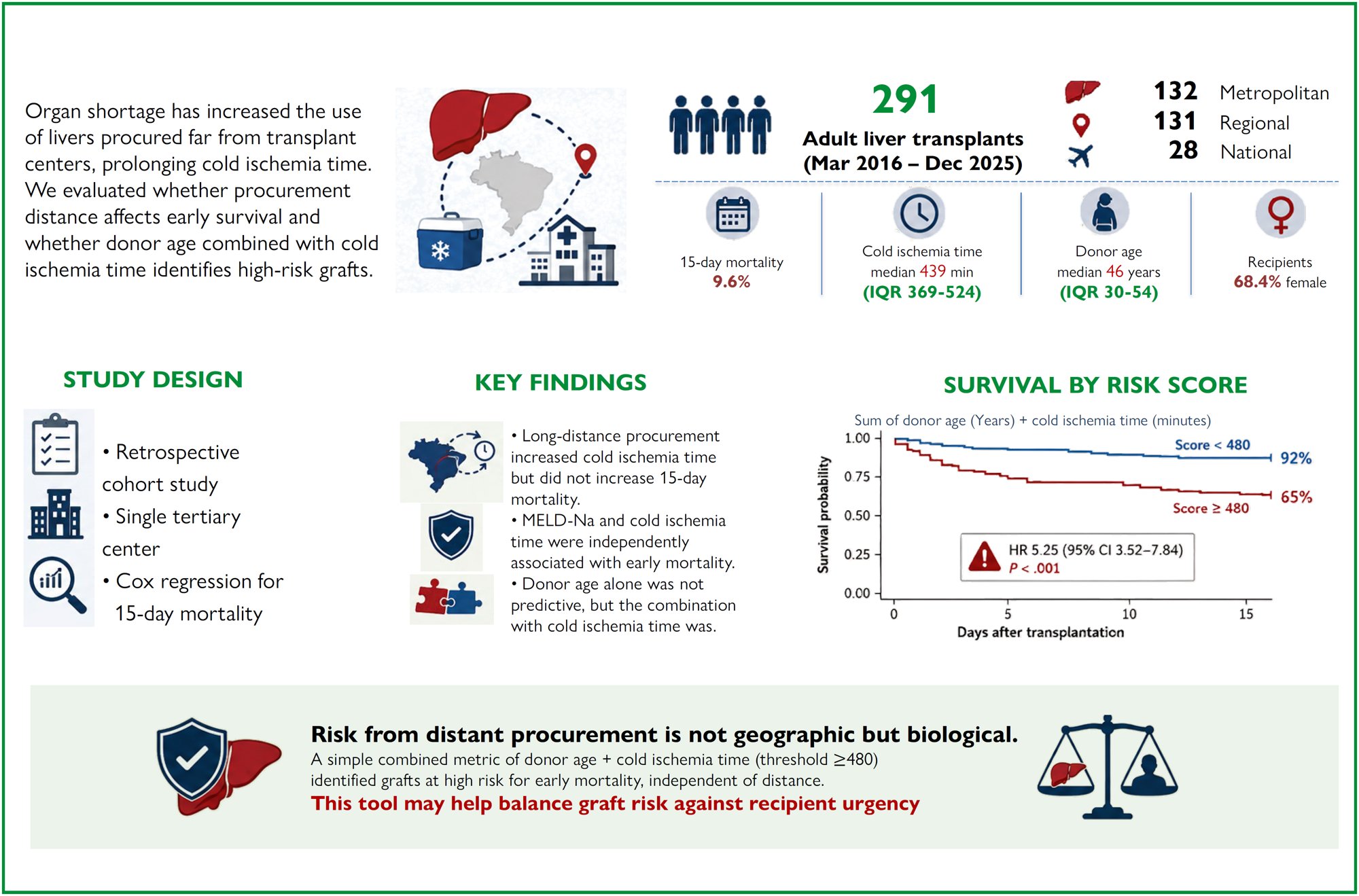
The increasing need to expand the donor pool has led to greater utilization of liver grafts procured at a distance from transplant centers, inevitably prolonging cold ischemia time. Whether long-distance procurement independently affects early outcomes or whether risk is primarily driven by donor-related factors remains uncertain.
We evaluated the impact of procurement distance on early post-transplant survival and investigated whether the combined effect of donor age and cold ischemia time could define a clinically meaningful risk threshold.
We performed a retrospective cohort study of adult liver transplant recipients from March 2016 to December 2025 at a single tertiary transplant center. Donor, recipient, and procurement variables were analyzed according to procurement location. Early mortality was assessed using Kaplan–Meier analysis and Cox proportional hazards modeling. Among 291 transplants, long-distance procurement was associated with significantly longer cold ischemia time but not with increased 15-day mortality. In multivariable analysis, recipient severity (Model for End-stage Liver Disease-Sodium score) and cold ischemia time were independently associated with early mortality, whereas procurement location and donor age alone were not. A composite variable defined by the sum of donor age and cold ischemia time identified a threshold (≥480) associated with significantly reduced early survival, conferring more than a fivefold increase in 15-day mortality independent of procurement distance.
These findings suggest that the risk associated with distant procurement is not geographic but biological, reflecting the interaction between donor susceptibility and ischemic burden. A simple combined metric may help clinicians balance graft-related risks against recipient urgency when evaluating marginal offers.




Developed by Surya MKT