


Understanding how people symbolize their illness and treatment and how they cope with it is important for healthcare teams and families. Meaning is a fundamental part of the human experience. It can act as a tool for progress or an obstacle. This is the case of expectant approaches, such as the watch-and-wait protocol, in which people wait and face uncertainty. This protocol is an organ-preservation strategy, in which eligible patients undergo rigorous follow-up and do not undergo surgery immediately after the neoadjuvant chemoradiotherapy stage.
To understand the symbolism attributed to the watch-and-wait protocol for patients with locally advanced low rectal cancer.
A clinical-qualitative study with semi-structured interviews with in-depth open questions and field notes. Sampling was purposive and limited because of information theoretical saturation. Data analysis included seven steps of clinical-qualitative content analysis, interpreted from the psychodynamic framework of medical and health psychology.
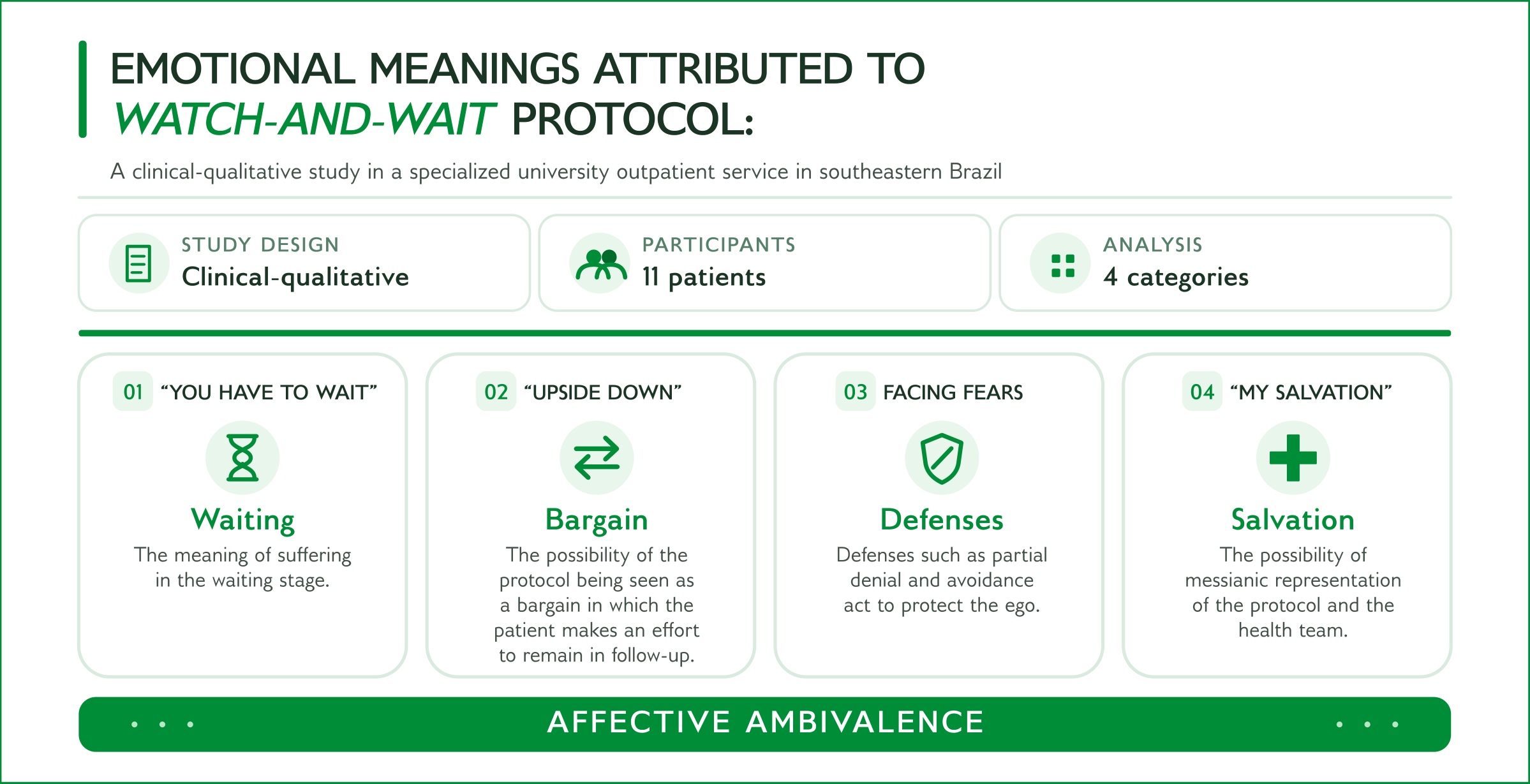
Four categories were selected: 1. “You have to wait”, which discusses anxiety and distress as a form of suffering; 2. “Upside down”, which addresses the fact that the protocol can be seen as a bargain; 3. “Facing fears”, which talks about defensiveness as a way to cope with distress; and 4. “My salvation”, which discusses the possibility of considering the protocol a messianic alternative.
Patients undergoing clinical oncological follow-up attribute conflicting meanings to the ‘watch-and-wait’ protocol. Positive meanings of salvation because it offers an alternative to surgery and a bargain to postpone surgery as long as possible, and negative meanings of suffering because of the uncertainty that causes distress.




Developed by Surya MKT