


Gastric neuroendocrine tumors (gNETs) are uncommon neoplasms arising from enterochromaffin-like cells, representing a distinct subset of gastric malignancies, with challenging clinical management.
To analyse the classification, treatment indication, and survival of patients diagnosed with gNETs.
We retrospectively analyzed patients diagnosed with gNETs between 2009 and 2025 at a high-volume tertiary center in Brazil. Clinical, pathological, and treatment data were reviewed, and tumors were classified according to World Health Organization and clinicopathological criteria into Types I, II, and III.
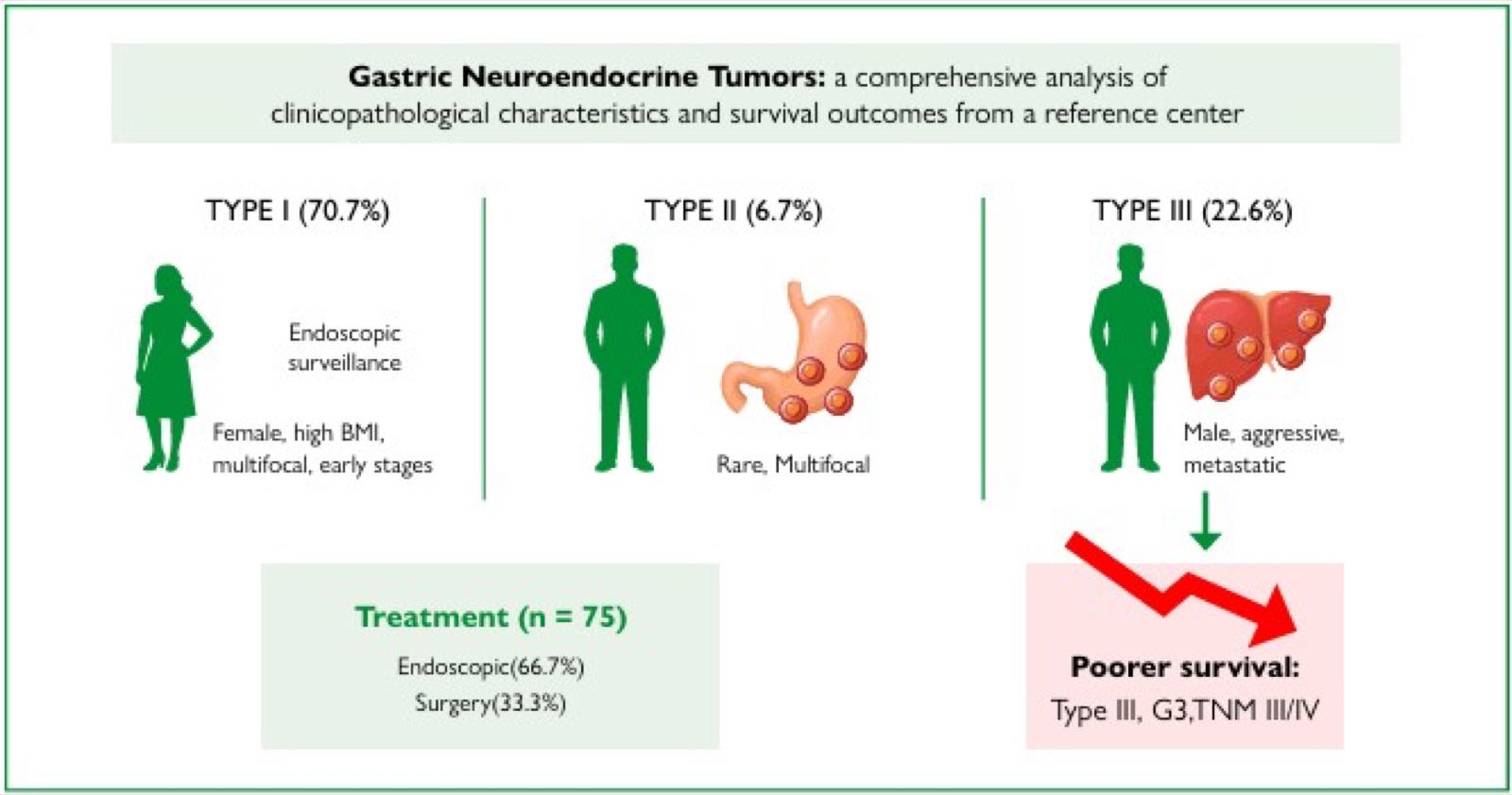
Of the 75 patients included, 53 (70.7%) were classified as Type I, 5 (6.7%) as Type II, and 17 (22.6%) as Type III. Treatment included surgery in 25 patients (33.3%) and endoscopic resection in 50 (66.7%). Type I tumors predominated in females (p<0.001), were frequently multifocal (p<0.001), associated with higher body mass index (p=0.002), and were mainly managed endoscopically (p=0.008). Type II tumors were rare and associated with multiple endocrine neoplasia Type 1, while Type III tumors were predominantly male, larger, high-grade (G3), and frequently metastatic, requiring surgical resection and palliative therapy. Among the 25 surgically treated patients, most were men (52%) and included 12 patients (48.0%) with Type I, 3 (12.0%) with Type II, and 10 (40.0%) with Type III tumors. Survival analysis showed significantly worse outcomes for Type III and G3 tumors. Multivariable analysis identified advanced age (hazards ratio 4.11; 95% confidence interval (95%CI): 1.14–14.80; p=0.030) and tumor, lymph node, metastasis (TNM) stage III/IV (HR 5.42; 95%CI: 1.26–23.26; p=0.023) as independent predictors of poorer survival.
gNETs exhibit heterogeneous clinical behavior, with Type I tumors predominating in the Brazilian population. Tumor type, grade, and TNM stage are critical determinants of prognosis and should guide individualized treatment strategies.




Developed by Surya MKT