

Collis gastroplasty for esophageal lengthening is a complex adjunct to hiatal hernia repair in patients with esophageal foreshortening.
To study the final morphology of the repair using state-of-the-art imaging: computed tomography with three-dimensional reconstruction.
Nine patients with prior Collis gastroplasty and hiatal hernia repair were studied with three-dimensional computed tomography reconstruction to evaluate the anatomy of the repair and screen for hiatal hernia recurrence. Secondary outcomes were quality of life and surgical morbidity.
After a medium follow-up of 34 months, objective recurrence of the hiatal hernia was observed in three patients (1.5, 2.2, and 3 cm), and two patients were symptomatic. The gastroesophageal junction tube (neo-esophagus) created by the gastroplasty was similar in shape and volume to the native esophagus in all patients. The fundoplication previously performed covered the neo-esophagus in only two of the nine patients. No fistulas or mortality were observed.
Collis gastroplasty reliably produces a tubular gastric conduit resembling the native esophagus in shape and volume. 3D CT is a promising tool for evaluating the postoperative morphology of the repair and anatomical recurrences, demonstrating the durable anatomical structure of Collis gastroplasty.
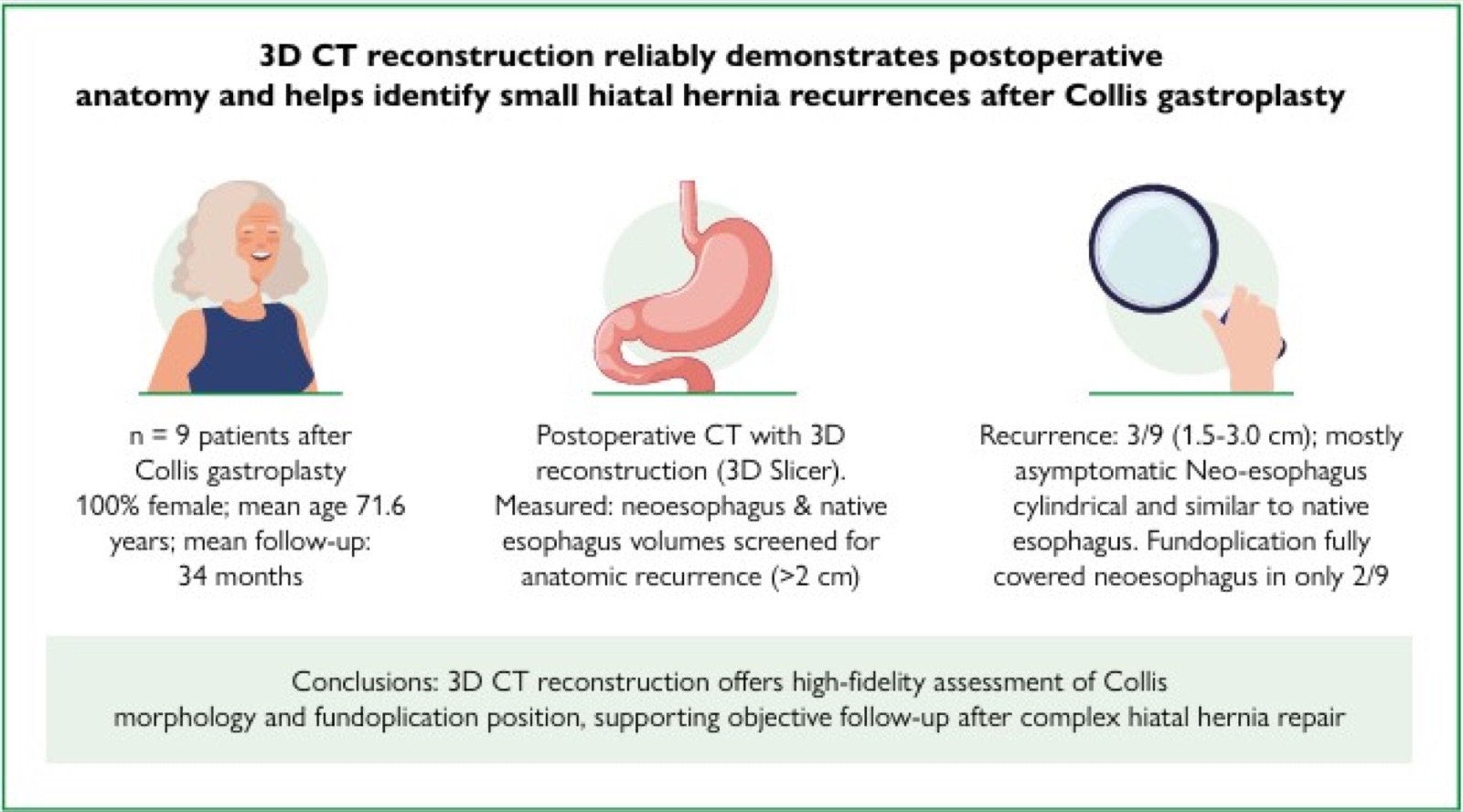
Collis gastroplasty for esophageal lengthening is a complex adjunct to hiatal hernia repair in patients with esophageal foreshortening.
To study the final morphology of the repair using state-of-the-art imaging: computed tomography with three-dimensional reconstruction.
Nine patients with prior Collis gastroplasty and hiatal hernia repair were studied with three-dimensional computed tomography reconstruction to evaluate the anatomy of the repair and screen for hiatal hernia recurrence. Secondary outcomes were quality of life and surgical morbidity.
After a medium follow-up of 34 months, objective recurrence of the hiatal hernia was observed in three patients (1.5, 2.2, and 3 cm), and two patients were symptomatic. The gastroesophageal junction tube (neo-esophagus) created by the gastroplasty was similar in shape and volume to the native esophagus in all patients. The fundoplication previously performed covered the neo-esophagus in only two of the nine patients. No fistulas or mortality were observed.
Three-dimensional computed tomography reconstruction of the gastroesophageal junction following hiatal hernia repair with Collis gastroplasty and fundoplication reliably demonstrates postoperative anatomy and helps better understand hiatal hernia recurrence.




Developed by Surya MKT