

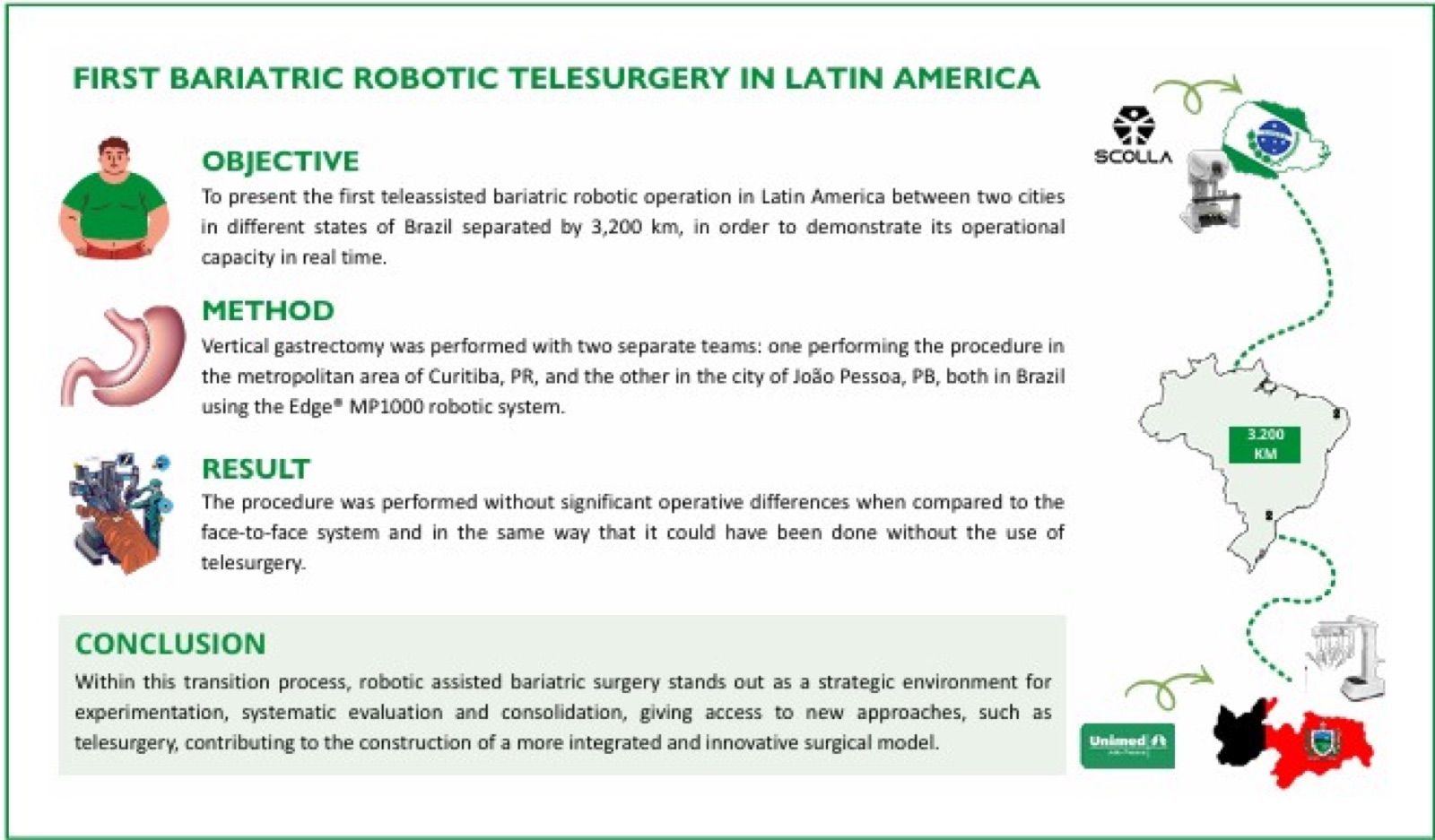
The use of robotic systems in bariatric surgery has reached a stage of maturity that supports its application with consistent results in the management of severe obesity. At the same time, the improvement of communication networks and digital support bases has renewed the debate on telesurgery as an alternative to extend the reach of specialized surgical care, particularly in contexts marked by the unequal concentration of highly complex services.
To present the first teleassisted bariatric robotic operation in Latin America between two states of Brazil separated by 3,200 km, in order to demonstrate its operational capacity in real time.
Vertical gastrectomy was performed with two separate teams: one performing the procedure in the metropolitan area of Curitiba (PR), and the other in the city of João Pessoa (PB), both in Brazil.
The procedure was performed without significant operative differences when compared to the face-to-face system and in the same way that it could have been done without the use of telesurgery.
Within this transition process, robotic assisted bariatric surgery stands out as a strategic environment for experimentation, systematic evaluation and consolidation, giving access to new approaches, such as telesurgery, contributing to the construction of a more integrated and innovative surgical model.
Robotic gastrectomy is gaining popularity worldwide. It allows reduced blood loss and lesser pain. However, it widespread use is limited by the extensive learning curve and costs.
To describe our standard technique with reduced use of robotic instruments.
We detail the steps involved in the procedure, including trocar placement, necessary robotic instruments, and meticulous surgical description.
After standardizing the procedure, 28 patients were operated with this budget technique. For each procedure material used was: 1 (Xi model) or 2 disposable trocars (Si) and 4 robotic instruments. Stapling and clipping were performed by the assistant through an auxiliary port, limiting the use of robotic instruments and reducing the cost.
This standardization helps implementing a robotic program for gastrectomy in the daily practice or in one`s institution.




Developed by Surya MKT