


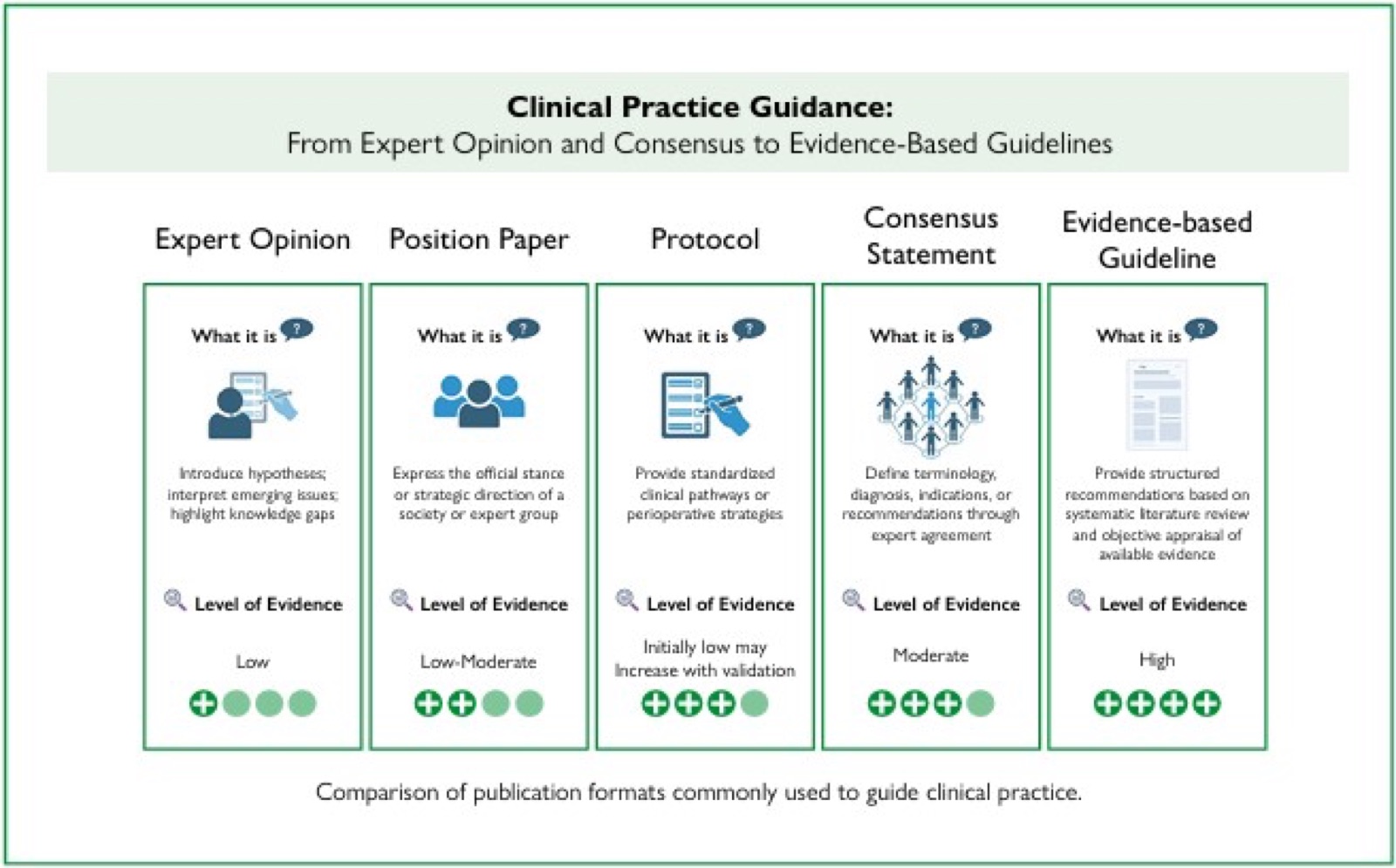
The growth of primary research in digestive surgery has led to an increasing need for structured interpretation and application to clinical practice. Guidance documents have become essential tools for decision-making. However, the terminology surrounding clinical guidance documents is frequently inconsistent, and different formats are often used interchangeably. Although review articles synthesize available evidence, they do not constitute clinical guidance unless their findings are interpreted through a framework explicitly oriented toward patient care, applicability, and decision-making. This review article clarifies the conceptual distinctions between expert opinion, consensus statements, position papers, protocols, and evidence-based guidelines. No single guidance format is universally superior, and each has its appropriate context. In digestive surgery, where randomized trials are often difficult to perform and evidence gaps remain frequent, structured interpretation is indispensable. As technology advances and real-world data become increasingly available, new methodological tools — including artificial intelligence and living systematic reviews — may enhance reproducibility and accelerate updates. Ultimately, clearer distinctions among guide orientations and greater methodological transparency may improve clinical judgment, stimulate research, and strengthen patient care in gastrointestinal surgery.




Developed by Surya MKT