


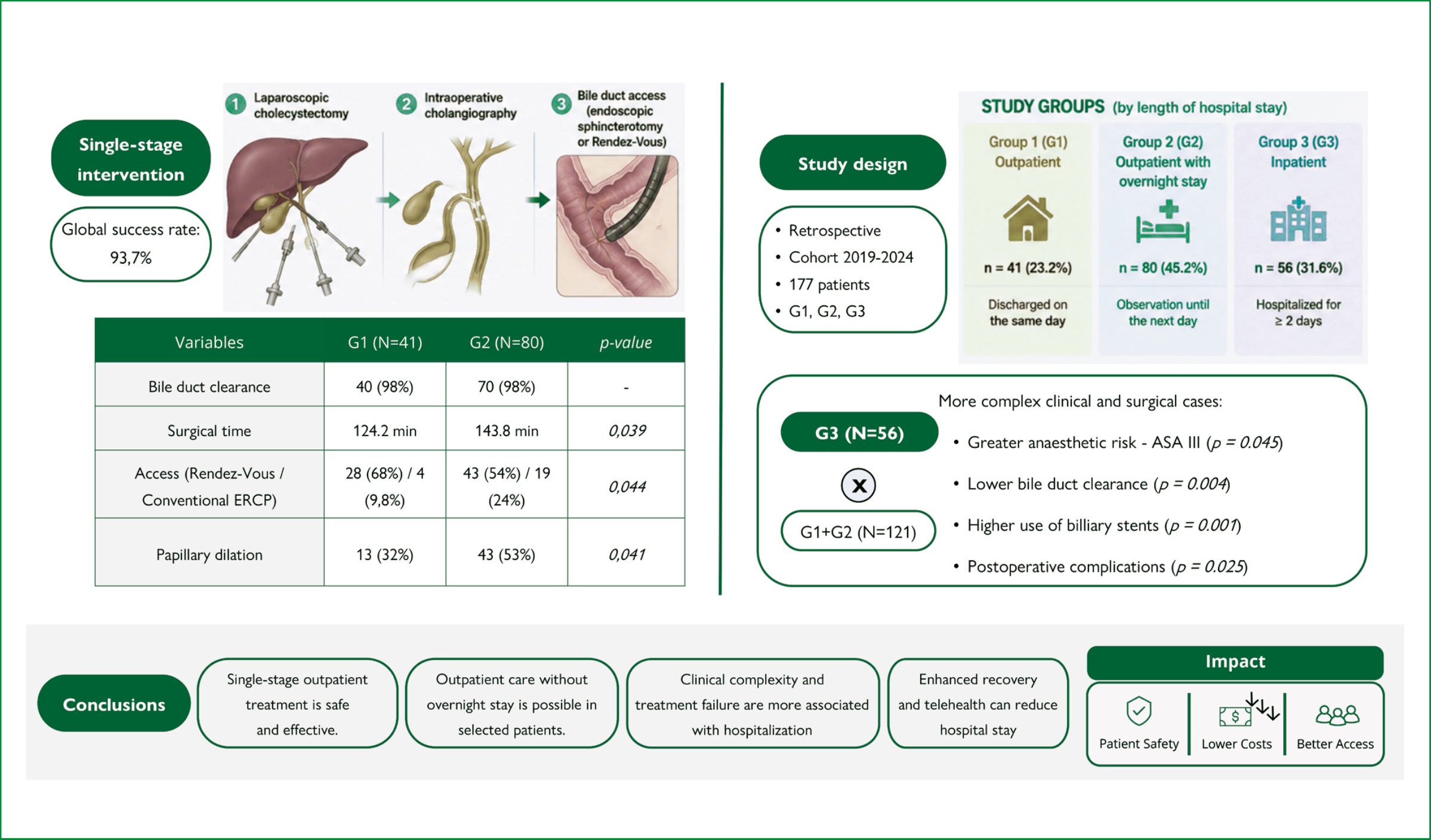
Single-stage outpatient treatment of cholecystocholedocholithiasis is feasible, highlighting the importance of appropriate patient selection, professional training, and healthcare service organization to support this approach.
To identify clinical and procedural factors associated with outpatient management and hospital stay following single-stage laparoendoscopic treatment of cholecystocholedocholithiasis.
A retrospective cohort study was conducted at hospitals affiliated with the Ribeirão Preto School of Medicine, Universidade de São Paulo (FMRP-USP), between 2019 and 2024. Patients were stratified into three groups according to care setting: outpatient (G1); outpatient with overnight stay (G2); and inpatient (G3). Clinical, surgical, and outcome data were analyzed using logistic regression models, χ2 tests, and Fisher’s exact tests (p=0.05).
Among 177 patients included, 41 were allocated to G1, 80 to G2, and 56 to G3. Compared with G2, G1 patients had shorter operative time (124.2 vs. 143.8 min; p=0.038), more frequent use of the Rendez-Vous technique (p=0.044), and less frequent use of papillary dilation (p=0.041). Patients in G3 had a higher prevalence of ASA III physical status (p=0.045), higher rates of postoperative complications (p=0.025) and biliary stent use (p=0.001), and lower bile duct clearance rates (p=0.004).
Single-stage outpatient laparoendoscopic treatment of cholecystocholedocholithiasis is safe and effective. Clinical severity, treatment complexity, and failure of bile duct clearance were more strongly associated with inpatient hospitalization, whereas overnight stay among outpatients was not associated with improved postoperative outcomes. The implementation of enhanced recovery protocols and telemedicine-based postoperative assessment strategies may further reduce hospital stay.




Developed by Surya MKT