


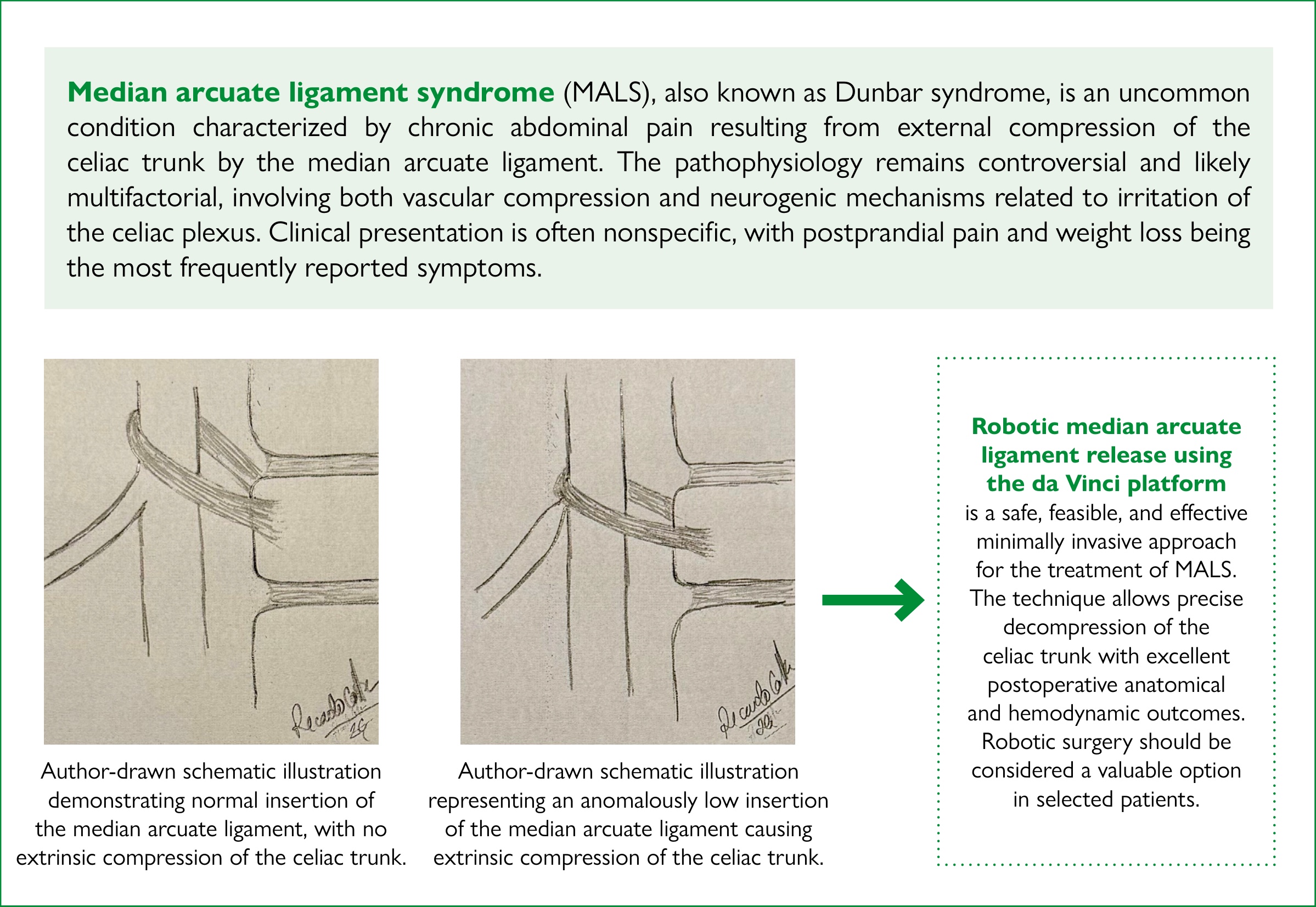
Median arcuate ligament syndrome (MALS) is an uncommon condition characterized by chronic and intermittent abdominal pain, typically postprandial, and weight loss, caused by extrinsic compression of the celiac trunk by the median arcuate ligament. The pathophysiology of the disease is not fully understood. Diagnosis is challenging due to nonspecific symptoms, and requires a careful correlation between clinical findings and imaging studies.
To demonstrate the feasibility, safety, and technical aspects of robotic median arcuate ligament release using a case-based approach with detailed imaging correlation.
The authors report the technical aspects in an elderly male patient with typical symptoms of MALS, who underwent robotic-assisted median arcuate ligament release using the da Vinci X platform. Preoperative evaluation included CT angiography and color Doppler ultrasound, demonstrating focal proximal celiac trunk stenosis.
The robotic approach allowed precise dissection and complete decompression of the celiac trunk without intraoperative complications. Postoperative imaging demonstrated resolution of the stenosis and normalization of Doppler flow parameters. The patient experienced complete symptom resolution, and remained asymptomatic after one year of follow-up.
Robotic median arcuate ligament release is a safe and effective minimally invasive option, providing excellent visualization and precise dissection in a challenging anatomical region. This technique should be considered a valuable approach for selected patients with MALS.




Developed by Surya MKT