


Pancreatic neuroendocrine tumors (pNETS) constitute a heterogeneous and rare disease worldwide. Diagnosis rates have been increasing, and the evaluation of prognostic factors has become even more important in the treatment decision-making process.
To present results and prognostic factors in patients undergoing surgical treatment for pNETS at a single Brazilian center.
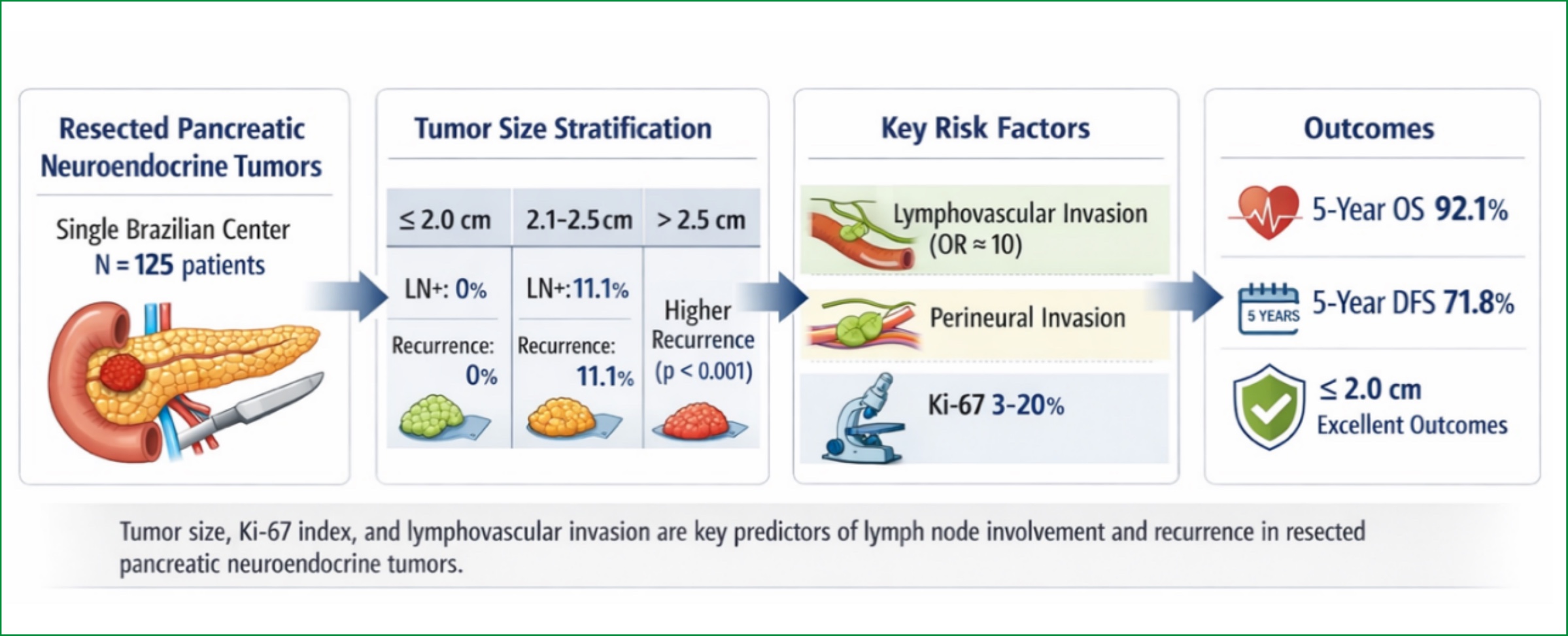
The most frequently performed surgical procedure was PCC+S 60.0%. The median hospital stay was 8 (5-13) days, and postoperative mortality occurred in 1.7%. Overall survival in 3 and 5 years was 93.8 and 92.1%, respectively. Disease-free survival at 3 and 5 years was 87.1 and 71.8%, respectively. Patients with tumors smaller than 2.0 cm did not present with lymph node disease or recurrence, and patients with tumors measuring 2.1-2.5cm had lymph node disease in 11.1% and recurrence in 11.1%. In univariate and multivariate analysis, the presence of lymphatic and perineural invasion and Ki67 (3-20) were strongly correlated with positive lymph node disease and recurrence, respectively.
The presence of lymphatic and perineural invasion, Ki67 (3 to 20), and tumors larger than 2.5 cm correlated with positive lymph node disease and recurrence.




Developed by Surya MKT